
Keep clear of spreading water and request prompt help from a qualified plumber or backflow-service provider appropriate to the actual system. Ask your water provider which repair and testing qualifications apply locally. Use only an already identified, authorized and safely reachable customer shutoff under its established instructions; obtain urgent isolation help when that is uncertain. Do not cap an outlet, bypass the assembly, turn test fittings or tighten the body. Report the exact water location without assuming the drinking water is safe, contaminated or under a particular advisory.
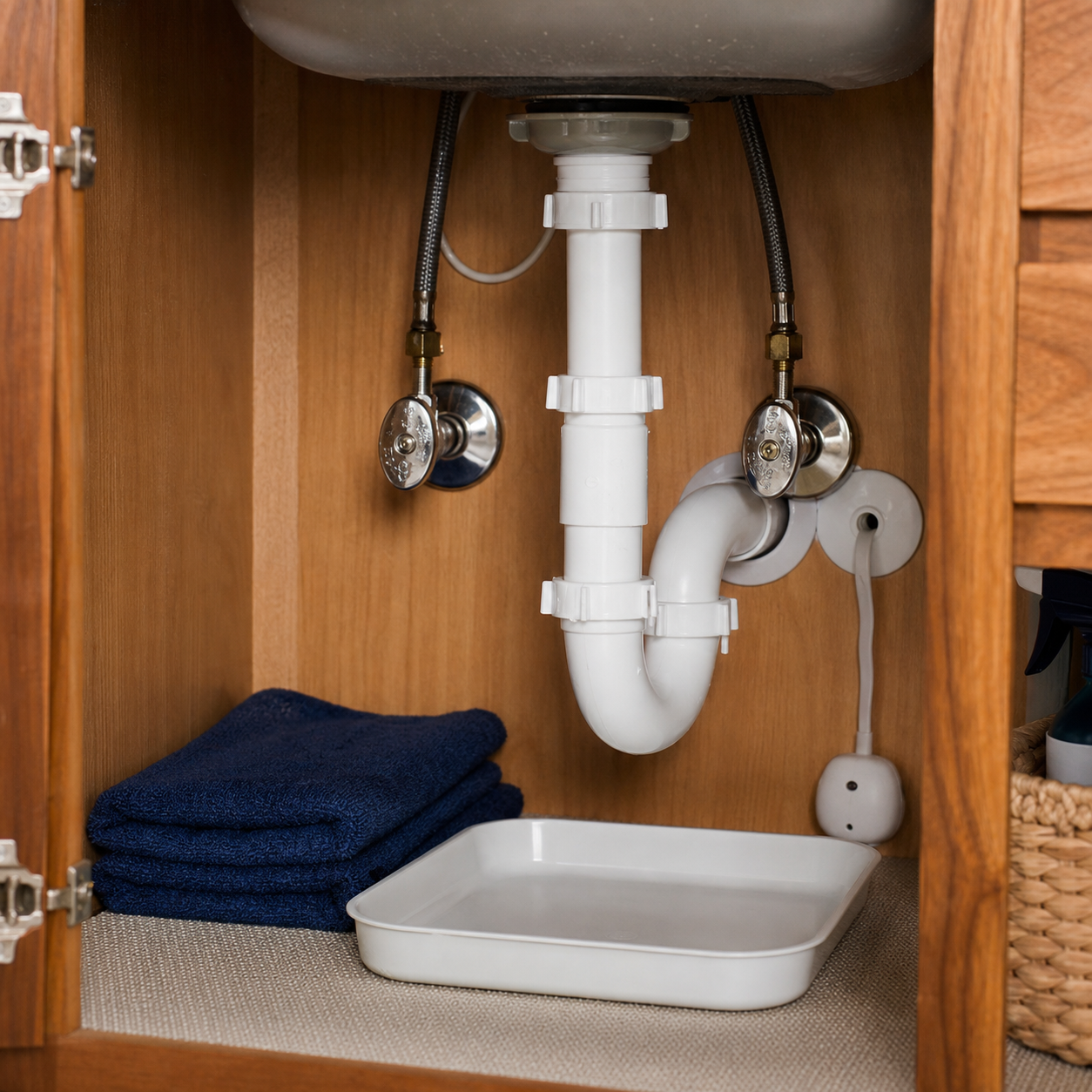

Keep clear and arrange safe water control
Keep children, pets and other people away from water, slippery paths, soft ground and wet electrical equipment. Do not open a flooded box, enter a crawlspace or follow piping through an unsafe area to identify the device. A model number or close-up photo is not required before requesting urgent help.
If a customer water shutoff has already been positively identified for you, is authorized for your use and is safely reachable, follow its established instructions without forcing it. Otherwise request urgent isolation assistance from the responsible plumber, building or utility contact. Say whether water is still spreading and what is threatened.
Do not use the handles on a backflow assembly as a guessed shutoff sequence. Do not operate a utility-owned, shared-building or fire-system control. Tell service what the assembly is known to supply; leave that field unknown if there is no reliable record. The household main may not control every connection.
CDC warns against operating electrical equipment or switching power while standing in water. Do not cross water to reach a plug, breaker, pump or controller. Keep cleanup equipment out until access and electrical safety are established. For immediate danger, leave and call 911 from safety.
Protection, pressure control and a dry floor are different findings
A supply backflow-prevention assembly helps keep water from a connected system from returning to the drinking-water supply. Portland’s water bureau describes cross connections involving irrigation, fire sprinklers and other equipment. Its public-health purpose explains why removing or bypassing a leaking device is not an acceptable way to hide the water.
A household pressure regulator has a different role. A water-heater relief device, hose-faucet vacuum breaker and wastewater backwater valve also have their own arrangements. Do not identify a component only from the letters PRV, a brass body, the number of handles or an online photograph. Use existing installation or test records and ask the provider to confirm it.
A stopped drip does not verify backflow protection. Likewise, a prior passing test does not explain a new external leak. Keep the leak finding, completed repair, required performance testing and actual water-use instructions as separate entries in the service record.
Report the location and known system to choose the next contact
Describe “water at the assembly near the irrigation supply” if that is all you know. Use observations already available from safety; do not wipe, touch, open or run the system to find the wettest point. Say whether the location is a body, connection or separate open outlet only when already known.
This original call table assigns a useful request without identifying a failed part. Ask the provider which work it is qualified to perform and who handles any separate test or water-authority requirement.
| Already known condition | Next useful contact or question |
|---|---|
| Continuing water threatens a room, walkway or safe access | Request urgent safe isolation and repair help; report wet electricity or unstable ground first. |
| Water appears at the body or a pipe connection | Tell qualified plumbing/backflow service the first visible location and timing. Do not tighten or select a seal from a picture. |
| Water leaves an open outlet associated with the assembly | Leave it unobstructed. Ask service to establish the actual device, discharge source and required repair; do not cap or redirect it. |
| The assembly is recorded as part of irrigation | Contact irrigation service and ask whether it can perform the required backflow work or must coordinate a qualified plumber/tester. |
| The supply is shared, public or connected to fire protection | Include the responsible building, utility or fire-protection contact. Do not experiment with the valves. |
| A pressure change, water-quality concern or official notice is also known | Report it separately to the serving utility and ask for address-specific water-use instructions. Leak appearance alone does not select an advisory. |
| Repair work is proposed or the leak has just stopped | Ask who completes any required test, submits the report and gives return-to-use instructions, separately from the leak repair. |
An open relief outlet is not a place for a plug
The actual current Watts LF009 resource page links RP/IS-009 2543, covering specified reduced-pressure-zone assemblies. Its installation drawings distinguish a relief outlet and air gap, and its discussion includes discharge conditions and drainage needs. That bounded example does not make every outdoor drip normal or diagnose an unknown assembly.
Do not cap, tape over, block, reduce or connect a hose to an uncertain outlet to divert water. Do not open a test cock, change an adjustment, flush the assembly, remove a cover or clean a check valve during this response. Keep the source and drainage assessment with qualified help for the actual model.
Ask what evidence explains the water and whether work is needed at the assembly, connection or drainage arrangement. A dry patch after a pressure change or controller stop does not establish that the protection is working. Report continuing or recurring water without reproducing it.
If a flood sensor is fitted, report any existing message along with the visible water. Watts distinguishes its sensor from an activated communication arrangement. A missing alert, cleared notification or stopped app display does not verify either isolation or repair. Do not change sensors, wiring or app setup to investigate an active leak.
Arrange the repair and any required retest as separate tasks
Ask your own water provider which qualifications, approvals and test/report steps apply to this installation. A person qualified to test may not offer every repair; a plumbing or irrigation visit may not include the required backflow test. Confirm the scope before treating a booking as a complete solution.
Portland directs repair questions to a licensed plumber or, for its irrigation systems, an appropriately licensed landscape contractor, and requires testing again after repairs. Replacement has a separate approval route there. Killeen also describes certified testing and report submission after repair. These are local examples, not a nationwide licensing rule or annual-test deadline.
Ask for the identified assembly, confirmed leak source, proposed work and the check following repair. Then ask who performs any required performance test, where the report goes and who confirms the remaining restrictions. The current Watts manual also distinguishes fire-system considerations; let the qualified fire-protection provider coordinate those rather than closing a valve yourself.
Retain the actual completed test result and report status, with the service date and unresolved actions. A new part, paid invoice, prior test sticker or appointment for later testing is not the same as a completed current test. If protection remains uncertain, obtain the responsible provider’s specific operating and water-use instructions.
Keep drinking-water advice separate from the leak diagnosis
A leak at a backflow device does not by itself establish an address-specific drinking-water advisory, and clear-looking tap water does not establish safety. Report a suspected cross-connection or water-quality problem to the serving utility promptly. Ask which household uses are restricted, what official update channel to use and who resolves uncertainty.
CDC distinguishes boil-water, do-not-drink and do-not-use advisories. Boiling does not make water containing harmful chemicals or toxins safe. Follow the actual notice and provider’s instructions; do not substitute a generic boiling, filter-changing, disinfecting or flushing procedure.
Keep the utility’s water-use status separate from the contractor’s repair or test result. Restored flow or a stopped outlet is not an official lifting of a restriction. The water-main notice guide helps record affected addresses, notice type and updates without assuming every plumbing event has the same response.
If water entered the home, arrange source correction and wet-material assessment promptly. EPA recommends experienced help for contaminated-water damage. Wet electrical equipment needs qualified evaluation; ESFI cautions that drying alone is not clearance. Keep these tasks on the free homeowner checklist alongside the equipment work.
Example: an irrigation repair and a test still to arrange
Fictional planning example: Nora notices water near equipment identified in an existing irrigation test record as a backflow assembly. She keeps people off the wet path and calls for qualified help, reporting the visible location and continuing water. She does not open the test fittings or attach a hose to the outlet.
The service visit stops the water, but the paperwork does not say whether a required performance test was completed. She asks her water provider and contractor who handles the applicable retest, report and return-to-use instructions. She records “leak work completed; test status pending” rather than marking every task finished.
The actual diagnosis and local requirements come from those providers. Any wet-wall or access damage gets a separate follow-up. This invented example shows how to avoid losing an open action; it does not identify a failed check, prescribe a test or promise that a particular repair will pass.
Private notes for the repair and protection record
Request urgent help first. Use only details already available safely; a photo or complete worksheet must not delay the call. Keep addresses, access arrangements, full identifiers and detailed test/service reports private.
- First visible water location, time and whether it continues: ___.
- Electrical, ground, fire-system, shared-supply or access concern: ___.
- Known system served and actual assembly/model from retained records, or unknown: ___.
- Established authorized isolation instructions and action already taken: ___.
- Plumbing/irrigation/backflow, water-provider and building contacts: ___.
- Confirmed source, agreed repair scope and completed work: ___.
- Required test, actual result, report recipient/status and return-to-use instructions: ___.
- Water-use notice if applicable, separate material/electrical tasks and next update: ___.
Report when the customer isolation control cannot be relied on
If an already identified customer shutoff leaks or does not stop continuing water under its established instructions, report that condition promptly. Ask the responsible plumber/building contact and actual serving utility to coordinate safe isolation. Do not substitute the backflow assembly’s handles or test fittings for a failed control. Include the fire-protection or other responsible provider when that connection is known.
The main-shutoff guide adds an original contact table and a fictional isolation-complete, repair-pending handoff. Once the supply-control work is addressed, this backflow guide’s actual assembly repair, applicable retest/report and water-use questions still need their own answers. A successful isolation does not verify backflow performance.
When to call a professional
Leave immediate fire, sparking, collapse, injury or unsafe escape conditions and call 911 from safety. Wet electrical access, unstable ground or uncontrolled water threatening the home needs urgent qualified help. Include the building contact for shared equipment, the actual utility for suspected public equipment or water-quality concerns, and a qualified fire-protection provider for an assembly serving fire protection. Do not guess at a fire-system or shared valve.
Related guides
Sources
- Watts: LF009 U.S. product resources — actual current installation/manual link and protection role
- Watts: RP/IS-009 2543, 1912105, ©2025 — bounded RP-zone assembly, drainage and testing example (PDF)
- Portland Water Bureau: Backflow prevention and cross-connection control — local repair, replacement and retesting roles
- City of Killeen: Backflow Prevention & Customer Service Division — local post-repair testing/report example
- CDC: Drinking Water Advisories — different restrictions and official instructions
- CDC: Reentering Your Flooded Home — standing-water electrical boundary
- EPA: Mold Cleanup in Your Home — source correction, moisture and contaminated-water help
- ESFI: Water-Damaged Electrical Equipment — evaluation before restoring power
- CPSC: current recalls and product-safety warnings
- City of Columbus: Locating a Water Meter & Emergency Service Valve — local plumber and utility isolation coordination
- Austin Water: Water Leaks — local customer cut-off and utility/service-line distinction
Free next step
Download the free seasonal maintenance checklist to record observations and follow-up tasks. See the seasonal maintenance routine for more context.
Affiliate disclosure
No affiliate links appear in this guide. If a reviewed recommendation is added, the disclosure will appear beside it.