
If a sink faucet keeps dripping or streaming after its normal control is off, arrange repair with the actual manufacturer or a qualified plumber. Do not force the handle farther. Some high-arc spouts release residual water after use, but that does not explain every persistent drip or water escaping around the base. If water is spreading, the basin may overflow or electricity is wet, stop ordinary use, keep clear and get urgent help; use only a known safe supply shutoff under its established instructions.
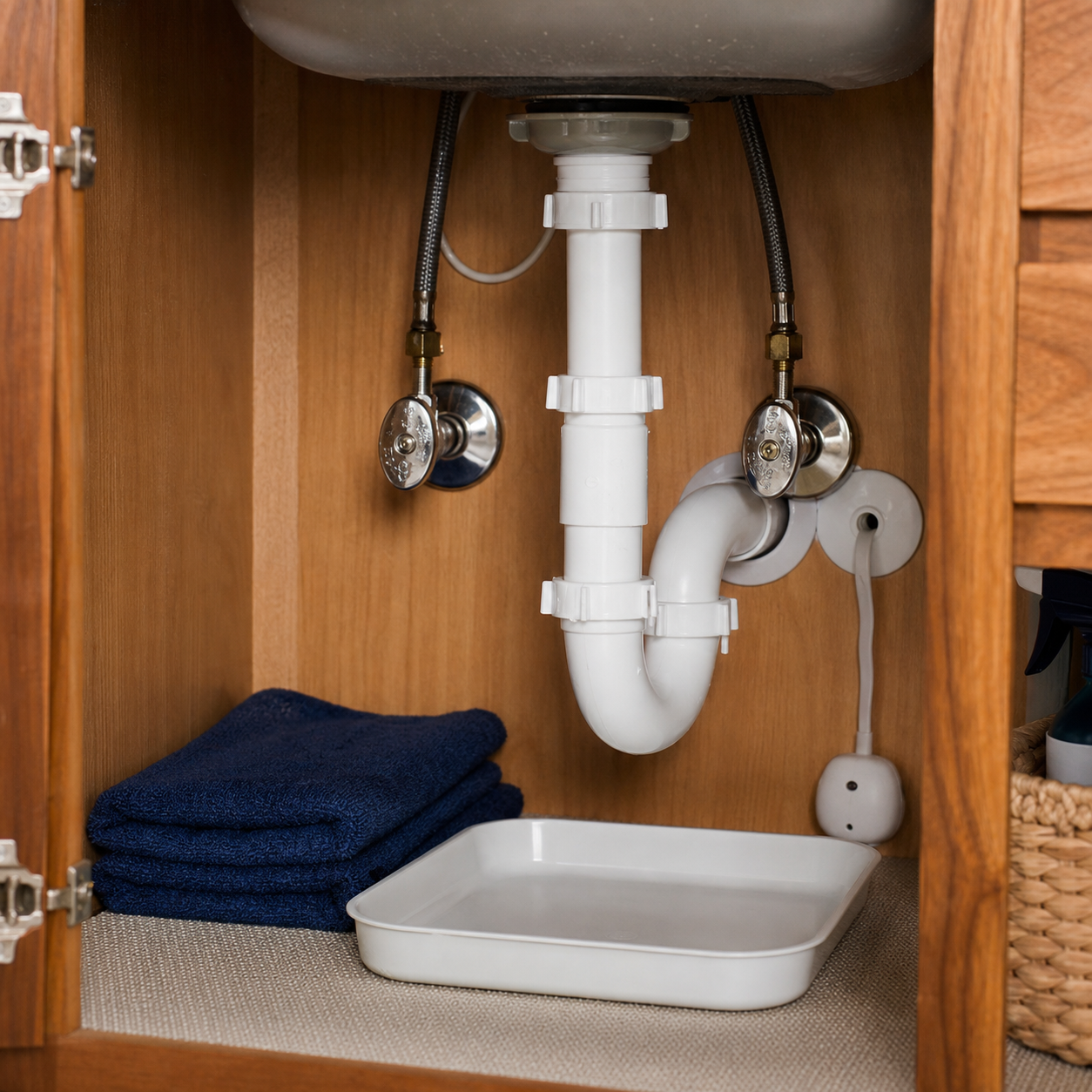

Start with where the water is going
Describe the first visible location before deciding what failed. Water coming from the outlet into the basin is a different observation from water around the handle, at the countertop or in the cabinet. More than one symptom can be present. Use what you have already seen; do not run another sinkful or move plumbing to reproduce the problem.
For spreading water or a basin that is filling, contact urgent plumbing or the building emergency contact. Keep people away from wet outlets, disposal wiring and appliances. CDC warns against operating electrical equipment or switching power while standing in water. Do not cross water to reach a breaker or pull a wet plug. Leave an immediately dangerous area and call 911.
If it is safe and the normal faucet control moves as expected, stop ordinary use without extra force. For continuing supply water, use only an identified, safely accessible fixture or customer shutoff whose operation you understand and are authorized to use. If it is stuck, damaged, leaking or unfamiliar, get isolation help instead of experimenting.
| Observation already made | Useful next step |
|---|---|
| Drops or a stream from the spout with the control off | Report whether it stops, continues or recurs, and identify the exact faucet before selecting repair parts. |
| Water around the handle or spout base | Give the location and design to the manufacturer or plumber; do not assume it needs the same part as a spout-end drip. |
| Water in the cabinet or below the sink | Stop sink use and follow the under-sink response. Supply, faucet and drain causes remain unconfirmed. |
| Basin filling, spreading water or wet electrical access | Prioritize urgent safe isolation and appropriate help. Do not rely on the drain or leave a container as the repair plan. |
Understand residual water without dismissing a continuing drip
Moen explains that water remaining past the arc of a high-arc spout can drain after the handle is off and should eventually stop. Its separate kitchen troubleshooting page addresses a faucet that continues dripping or streaming when switched off. These are different behaviors, not a reason to call every drip normal.
Give the manufacturer the actual model and the behavior already observed: a short tail after use, a continuing drip, a stream or an uncertain pattern. Ask whether the installed design explains it and what follow-up is appropriate. There is no universal waiting time in this guide, and you do not need to run repeated cycles to collect evidence.
Residual outlet water does not explain a wet cabinet, damage around the base or an overflowing basin. Treat those as separate problems even if outlet dripping later stops. A stopped drip alone does not prove that a source repair or wet-material follow-up is complete.
Why a look-alike cartridge is not a repair plan
Moen describes its internal cartridge as the component controlling flow and identifies it as a common reason a kitchen faucet does not shut off properly. Its cartridges vary and are not interchangeable. A handle-mechanism problem can also matter; the symptom alone does not identify the correct replacement.
Other designs use different parts. Delta’s two-handle lavatory support discusses seats, springs and stem assemblies. That is an example of a particular repair system, not a parts list for every Delta faucet or an instruction to fit those parts to another brand.
Moen also treats water between the spout and handle differently by faucet design. That is why the report should name the location as well as “leaking faucet.” Do not buy a generic washer, cartridge or seal kit solely from a photograph, handle count or a matching finish. Have the exact model and applicable parts document confirmed first.
Find the instructions before deciding who should do the work
Start with an existing receipt, installation sheet, product record or safely visible identification. Keep the kitchen/bathroom location, brand, full model and generation if known together. A normal exterior photo may help support; removing a handle, crawling beside wet wiring or pulling connections apart is not required to make the call.
Ask the manufacturer to confirm the document and compatible part for that installed version, including any electronic or special controls. Ask what the repair requires and whether a qualified installer is the appropriate next step. Warranty eligibility, parts availability and the need for replacement must be checked for the actual fixture; none is promised here.
Moen’s supply guide requires water isolation before repair. Its INS2049 installation sheet, dated March2011, likewise cautions about supply shutoff before removal or valve disassembly and verification of complete isolation. The sheet is a safety example, not confirmation that it applies to your faucet or a current repair sequence for every generation.
The handle being off is not that verification. Before any suitable owner repair, the actual instructions, correct parts, safe access and reliable isolation must all be understood. If any is missing—or a valve will not close normally—use qualified help. This guide does not teach handle removal, cartridge extraction or a valve-turning sequence.
Ask about repair and replacement as separate scopes
Once the symptom and fixture are identified, ask what a proposed repair addresses, which compatible part is specified, and what happens if the faucet body or supply control also needs work. If repair cannot resolve the leak or supported parts are unavailable, ask about a suitable replacement and its installation requirements. A new faucet purchase does not, by itself, solve an uncertain supply connection or damaged cabinet.
EPA includes repair and, where leaks remain unresolved, fixture replacement in its leak guidance. Use that as a reason to obtain an appropriate plan, not a guarantee that one inexpensive part will fix every faucet. The repair-estimate guide helps separate investigation, identified repair, additional findings and any wet-material work.
A drip noticed during a higher-bill investigation is useful information, but its appearance does not measure the volume lost or prove it explains every charge. Keep actual utility readings and comparable billing periods separate from the repair report. Do not apply a generic annual drip statistic to your own bill.
Example: a tall kitchen spout still drips after dinner
Fictional example: a household notices drops from a tall spout after normal washing-up. The counter and cabinet appear dry from a safe position. The household records what it already observed and gives manufacturer support the existing model record. They do not turn the handle harder or order the cartridge used in a neighbor’s faucet.
If the behavior continues or does not match the confirmed design guidance, they arrange the appropriate repair and resolve the supply-isolation plan before work. If water begins escaping into the cabinet or the basin fills, the response changes to prompt containment/isolation help and the under-sink or overflow concern. The example does not diagnose a cartridge, set a waiting period or certify hidden areas as dry.
Keep a useful repair record
Call first for active or unsafe water. Save only details available without creating another leak or delaying help. Use the free homeowner checklist for unresolved follow-up; a completed form is not a repair.
- Fixture location, full model and source of identification: ___.
- First visible water location and observed behavior after ordinary use: ___.
- Spreading water, filling basin, wet electricity or cabinet concerns: ___.
- Known supply control and safe instructions; isolation help needed: ___.
- Manufacturer document, confirmed compatible part or proposed replacement: ___.
- Provider, actual repair completed and instructions before normal use: ___.
- Remaining recurrence, supply-control or affected-material follow-up: ___.
A dedicated instant-hot spout needs its own system instructions
An ordinary high-arc faucet’s residual water explanation does not establish what is happening in a heated drinking-water dispenser. Identify the actual faucet and tank together from existing records, report the outlet and any cabinet water separately and keep clear of hot discharge and wet power. Do not transfer a cartridge choice or supply-control sequence between those systems.
The instant-hot-water dispenser leak guide adds vented-system limits, a service-question table and separate repair, filling/return-to-use and material-recovery tasks. A manufacturer’s initial-heating note is not clearance for continuous dripping or escaped cabinet water. Request qualified help when the actual stopping instructions or safe access are uncertain.
When to call a professional
Stop and contact a qualified plumber or other appropriate professional if water is actively spreading, you cannot safely find the shutoff, the leak involves a wall or ceiling, or a repair would require changing plumbing.
Related guides
Sources
- Moen: Kitchen Faucet — Leaking From the Spout; flow-control cartridges and identification
- Moen: High-arc spout after shutoff — residual water explanation, not a universal diagnosis
- Moen: Kitchen faucet leaks between the spout and handle — location/design-specific parts
- Moen: How to Turn Off the Water Supply to the Faucet — supply-isolation prerequisite
- Moen: INS2049, March2011 — installation-sheet supply-isolation caution, page1 (PDF; applicability must be confirmed)
- Delta: Two-handle lavatory spout drip — seats/springs and stem example; not universal part selection
- EPA WaterSense: Fix a Leak Week — faucet leaks and repair/replacement context
- CDC: Reentering Your Flooded Home — standing-water electrical boundary
- Moen: IH2300 current product resources — linked applicable instruction sheet
- Moen: SIP faucet and IH2300 guide INS14046B, April 2026 — safety, vented-system scope, filling, maintenance and troubleshooting
- Moen: Instant Hot SIP Faucet and Tank — Leaking; outlet, handle, spout-base and under-sink distinctions
- InSinkErator: Showroom Collection Installation, Care & Use, 45495-ISE Rev C, copyright 2023 — safety page 2; supplied tank manual also required
- EPA: Mold Cleanup in Your Home — source correction, drying and experienced contaminated-water help
Free next step
Download the free seasonal maintenance checklist to record observations and follow-up tasks. See the seasonal maintenance routine for more context.
Affiliate disclosure
No affiliate links appear in this guide. If a reviewed recommendation is added, the disclosure will appear beside it.