
For unexplained water on the floor, keep the affected dehumidifier unused and people clear of wet electrical access. Stop a running unit only through its established safe instructions from a dry, reachable position; ask urgent qualified help when access or isolation is uncertain. Contact manufacturer support for the exact service route. Do not move, open or run the unit to diagnose the leak. A bucket collects water for manual emptying. A gravity hose needs an appropriate downward route to a drain. A pump-equipped arrangement can move water to a permitted elevated destination within its stated limits. Confirm the exact model, port, hose and operating mode before connecting anything. A hose attached to a dehumidifier does not prove that water is draining correctly.
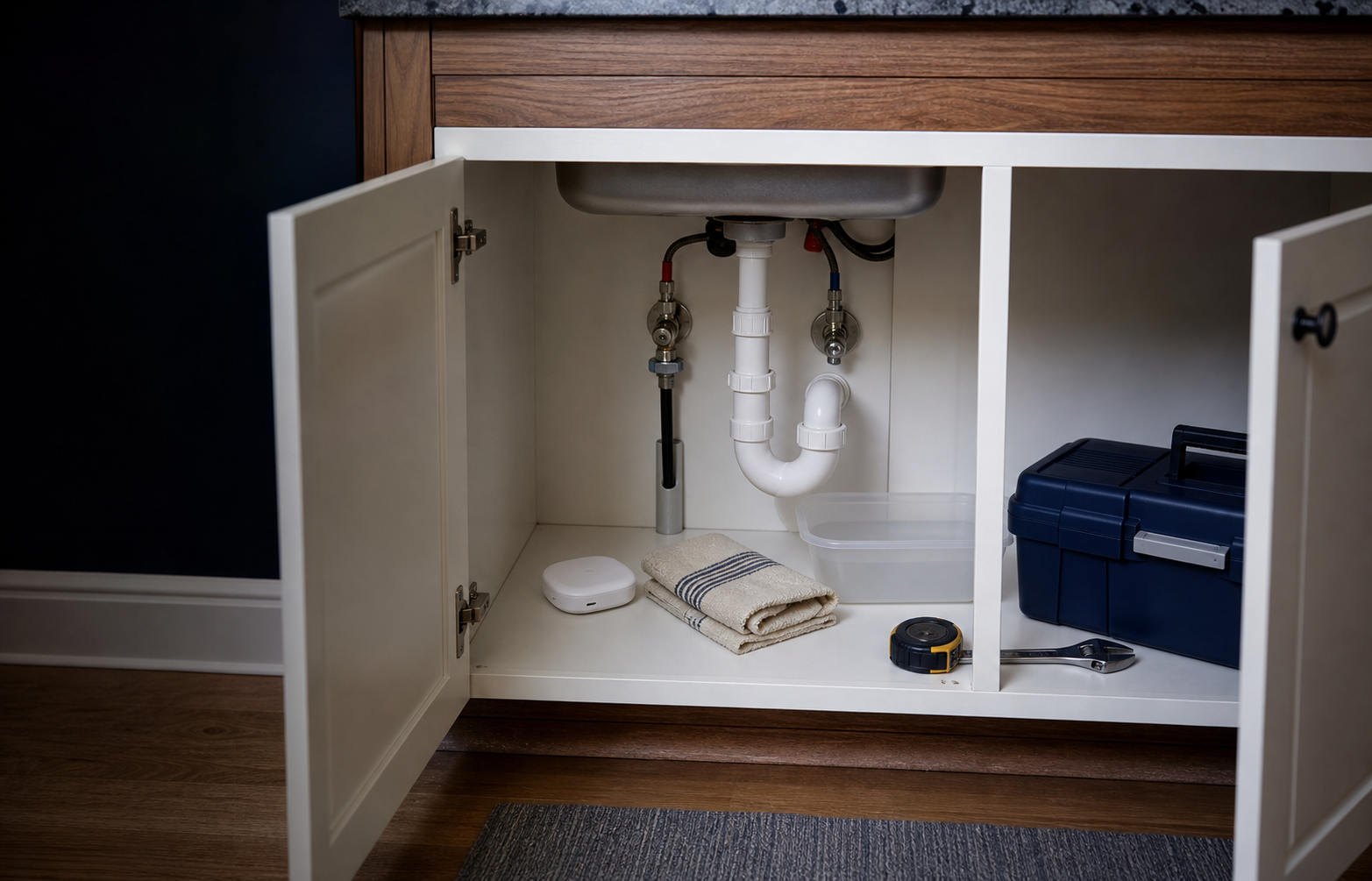

Water on the floor needs a response before drainage planning
Keep people clear of spreading water, wet cords, plugs and controls. Keep the affected dehumidifier out of use. If it is running, follow only its established safe stopping instructions from a dry, safely reachable position; obtain urgent qualified electrical or building help when access or isolation is uncertain. Do not enter water to unplug it. Leave immediate fire, sparking, injury or suspected-collapse danger and call 911 from safety.
Do not lift the unit off its bucket, roll it, pull a hose, empty it while running or start another cycle to locate the leak. The identified Midea manual warns about water entering the appliance, wet hands and removing a bucket during operation. Those warnings do not make a wet plug safe to touch. Report an uncertain water source rather than assuming collected condensate is clean.
For ordinary unexplained escaped water without immediate danger, contact official manufacturer support promptly to identify the applicable service route. Ask whether a local provider services this exact type of dehumidifier. GE’s page notes that its Bodewell service does not repair dehumidifiers; that is a GE-specific limitation, not a rule for every brand. An actual house-drain backup or building leak needs its own plumbing or building response.
Describe where water escaped without assigning the failed part
From an existing safe position, report the first wet area, timing, any message already displayed and the arrangement documented in the household record. Frigidaire describes different possibilities at a bucket, hose and base. A puddle or a full indicator does not establish which possibility applies.
Use this original contact table to organize the call. Do not approach the back, remove a bucket or repeat operation to fill in a missing answer. Keep unknowns explicit.
| Already known observation | Useful question or contact |
|---|---|
| Water at the bucket area | Give manufacturer support the model and known bucket arrangement; ask what assessment is needed rather than assuming a seating fault. |
| Water beside a hose or its destination | Report the documented gravity/pump route and first wet location. Ask appliance support about its arrangement; involve plumbing/building help for the actual drain. |
| Water under the base; path uncertain | Request model-specific service guidance. Do not tilt the unit, open a cover or chip visible frost. |
| A pump warning or full-bucket message already seen | Copy it exactly and report the leak separately. A stopped unit or cleared message does not establish a repair. |
| Water near a cord, receptacle or powered equipment | Keep clear; seek urgent qualified electrical help for unsafe access or isolation, then coordinate appliance assessment. |
| Nearby drain backup, rain entry or spreading water | Use the relevant wastewater or basement-water response and urgent building/plumbing help. Do not use the dehumidifier to test or dry the event. |
Retained bucket water and escaped water are different questions
The specific MAD50PS1BQGR pump-mode example below intentionally retains water in its bucket. That does not explain water on the floor or clear another appliance. Its drawings show separate gravity and pump arrangements; a similar hose, “Continuous” display or quiet pump cannot establish that the correct configuration is present.
Ask support to resolve the actual model, selected arrangement, observed fault and next action together. Keep a suspected connection or bucket problem separate from a confirmed finding. Do not copy a generic hose-removal, fitting-tightening or error-reset tip into an active leak. The ordinary setup and care sections later in this guide apply only after unexplained escape and unsafe equipment conditions have been addressed.
Example: a quiet pump and an unresolved puddle
Fictional example: a household sees water at the edge of a portable dehumidifier after previously using a pump arrangement. The pump is now quiet. The owner keeps the unit unused, keeps people clear of wet electrical access and contacts manufacturer support from safety. The note says “First wet area beside the hose; actual source not confirmed.”
The household does not remove the hose or restart the appliance to demonstrate the fault. It asks which provider handles this model, whether the drainage destination needs separate attention and what assessment or work must precede reuse. Wet flooring remains an open task even after a source finding. This invented example illustrates a handover, not a successful repair or product test.
Keep source repair, equipment use and wet materials separate
Ask the responsible providers what caused the escape, what was corrected and how the completed work was verified. For water-exposed electrical equipment, obtain the appropriate qualified assessment and specific return-to-use instructions. ESFI cautions that drying alone does not establish electrical safety. Do not use a dry-looking floor or a reset indicator as permission to reconnect the unit.
EPA calls for fixing the water problem and drying affected items completely; significant damage or contaminated water needs appropriately experienced help. A repaired hose does not resolve flooring, concealed moisture or another building source. Keep the appliance unused if its condition or actual instructions remain unresolved. The free homeowner checklist can hold each contact and open action; keep detailed reports private.
- First visible water, timing, recurrence and ongoing spread: ___.
- Electrical, structural, contamination or unsafe-access concern: ___.
- Exact model and document reference from safely available records: ___.
- Known bucket/gravity/pump arrangement, route and already-seen message: ___.
- Manufacturer/service, electrical and building/plumbing contacts and instructions: ___.
- Confirmed source and completed correction, distinct from a suspected cause: ___.
- Specific equipment-use instructions, restrictions and unresolved assessment: ___.
- Wet-material follow-up, responsible person and next update: ___.
Separate removal capacity from bucket capacity
ENERGY STAR describes dehumidifier capacity in pints per 24 hours and distinguishes bucket collection from hose drainage. That removal rating does not tell you how much the bucket holds or how often your household will empty it. Record the bucket information from the actual owner instructions separately.
Start with the full model and manual. Confirm which water-removal arrangements the appliance supports; a family name or a similar-looking control panel is not enough. Keep its safety, placement, temperature and care requirements with the drainage plan. This guide covers portable-unit planning, not whole-home equipment installation.
Choose an arrangement the actual appliance supports
Midea’s support FAQ distinguishes gravity-fed continuous drainage from pump-equipped units and directs owners to their model instructions. Use the table to identify the questions to resolve, not as a universal installation sequence.
| Arrangement | What the household needs to establish |
|---|---|
| Bucket collection | Applicable full-bucket indication, correct seating, safe emptying method and someone able to complete the task. |
| Gravity drainage | Correct port/hose and a permitted downward route to an appropriate drain, without kinks or an upward obstruction. |
| Pump drainage | A pump-capable model or approved arrangement, the specified connections and hose, allowable lift/route and continuing bucket/filter care. |
Keep operating modes and drain connections distinct
A “Continuous” humidity-control setting does not by itself identify the hose arrangement. Midea’s FAQ discusses that setting separately from its gravity and pump connection guidance. Read the drainage section as well as the control description.
The Midea MAD50PS1BQGR manual illustrates why details matter: it separates bucket, bucketless, continuous-drain and pump modes. Its pump arrangement uses the bucket and leaves some water there to keep the inlet submerged. It specifies a pump lift of up to 14 feet above the drain port for that model. Do not copy that height, remove a required bucket or substitute one port’s instructions for another appliance. These are manufacturer-document examples, not a product recommendation or a Level & Latch test.
Plan a real route before treating the hose as finished
Sketch the appliance position, connection and drainage destination. For gravity drainage, Frigidaire’s support guidance calls for the hose to remain below the connection, as straight as possible and without kinks. A route that rises over a doorway or sink edge needs further resolution; attaching the hose does not create a pump.
Use the exact model’s permitted hose, port, route and destination instructions. Confirm the drain itself is suitable and available; obtain qualified help if that is unclear. Do not make a precarious shelf or improvise electrical or plumbing changes to force a route to work. Keep access and walking paths clear.
The reviewed Midea manual also requires a level, sturdy location and model-specific airflow and temperature limits. Its outdoor-hose warning addresses freezing; it does not authorize using the appliance outdoors. Follow the actual unit’s power instructions, keep electrical connections away from water and do not bypass a float or other protective control.
Keep drainage observation and care on the household list
The following is ordinary observation after safe setup, with no unresolved leak or equipment hazard. It is not a test to perform on a leaking appliance.
After following the applicable setup instructions, observe the accessible hose connections, route and destination as the appliance operates normally. Note leakage, backing-up water, a full-bucket indication or a displayed warning. Do not mark drainage verified solely because the fan runs or because a hose is attached.
Frigidaire notes that debris can restrict a drain hose and cause water to back up into the bucket. Its full-bucket protection description is not a guarantee that every installation cannot leak. Keep hose care, bucket care and any pump/filter attention on the actual manufacturer’s schedule.
The Midea pump example still requires bucket attention; pump operation is not maintenance-free. If the route leaks, a warning persists or a connection cannot be fitted as instructed, stop the task and use manufacturer support or qualified service. If water is near electricity, use the leak-response guidance and appropriate emergency help rather than reaching through water to investigate.
Example: a hose rising to a laundry sink
Fictional example: a household places a gravity-drain-capable unit on a level floor and sketches a hose rising to the rim of a laundry sink. The record says “Gravity route not resolved,” not “Continuous drain complete.” The owner checks for an appropriate lower destination or an actually supported pump arrangement with manufacturer or qualified guidance.
The owner does not raise the appliance onto an unstable stack or assume a pump button exists because another model has one. The final note separates the confirmed arrangement, correct setup, observed drainage and next care task. This is an invented planning example, not an installation approval, inspection or successful product test.
Copy a short water-removal plan
Use the free homeowner checklist’s equipment and follow-up areas to point to this record. Keep unanswered questions visible rather than checking off a connection that has not been confirmed.
- Full model and applicable owner-document reference: ___.
- Supported bucket/gravity/pump arrangement and required control mode: ___.
- Specified hose, port, fittings and any required bucket/float position: ___.
- Stable appliance location, route and suitable drainage destination: ___.
- Applicable lift, airflow, temperature and electrical-placement requirements: ___.
- Date and accessible drainage observations; warning or leak noted: ___.
- Bucket/hose/filter care, responsible person and next review: ___.
- Unresolved fit, route or moisture issue and qualified follow-up: ___.
Keep moisture problems and product status separate
Removing collected water does not explain recurring stains, seepage or mold-like growth. Retain those observations in the condensation guide’s broader record and seek appropriate assessment. Do not use a portable-unit drainage plan as a flood-drying or mold-remediation procedure.
Check the exact product’s current recall information using the recall-checking guide, especially before putting a stored unit back into use. CPSC has recalled dehumidifiers across multiple brand names; a brand alone is not the matching identifier. A manual being available and a search returning no match do not establish safety clearance.
A working collection route does not resolve basement water entry
For repeated basement water after rain, keep the moisture-source assessment separate from the portable unit’s hose or bucket record. Minnesota Extension explains that dehumidification and interior coatings can leave an underlying water problem unresolved. A full bucket does not identify where liquid entry originates or select a foundation repair.
The basement-water guide provides questions for qualified source/drainage assessment and separate wet-material follow-up. Follow flood and electrical precautions before approaching equipment; this portable-appliance guide does not authorize a basement pump-out or use in a flooded room. Record the unresolved building problem even when the unit’s ordinary drainage is confirmed.
A portable AC drying mode needs its own appliance instructions
If the floor-standing appliance is actually a portable air conditioner, use its exact AC instructions even when a drying or dehumidifying mode was selected. This dehumidifier’s bucket/gravity/pump examples do not identify the AC’s ports, protective indication or supported service route. Keep unexplained escaped water and wet electrical access on the urgent response path.
The portable-AC leak guide adds a full-indication-versus-floor-water example and a model/mode/service question table. Do not run a new mode or move the appliance to compare. Keep its source correction, specific return-to-use instructions and wet-floor work assigned separately.
When to call a professional
Leave immediate fire, sparking, injury or suspected-collapse danger and call 911 from safety. Unsafe electrical access, spreading water, drain backup or building damage needs urgent qualified help. Ask the manufacturer which provider services the actual appliance; coordinate electrical, plumbing/building and wet-material work as needed.
Related guides
Sources
- ENERGY STAR: Dehumidifiers — removal capacity, bucket/hose options and operating conditions
- Midea: Dehumidifier FAQ — control modes, gravity drainage and pump-equipped units
- Midea MAD50PS1BQGR: User manual — model-specific modes, placement and drainage examples (PDF)
- Frigidaire: Dehumidifier Not Draining — gravity route, kinks and hose restrictions
- CPSC: Dehumidifiers Made by Midea Recalled — historical multi-brand example; exact identifiers determine applicability
- University of Minnesota Extension: Moisture in basements — source assessment and limits of coatings/dehumidification
- Nebraska Extension Disaster Education: Pumping a Flooded Basement — outside-water pressure warning
- GE Appliances: Dehumidifier — Leaking, Water on Floor; model and service routing
- Frigidaire: Dehumidifier — Water Leaking Issues; location-specific possibilities, not a diagnosis
- CDC: Reentering Your Flooded Home — electrical access and standing-water boundary
- ESFI: Water-Damaged Electrical Equipment — qualified assessment before restoring power
- EPA: Mold Cleanup in Your Home — source correction, complete drying and contaminated-water help
- CPSC: current recalls and product-safety warnings — compare exact identifiers
Free next step
Download the free seasonal maintenance checklist to record observations and follow-up tasks. See the seasonal maintenance routine for more context.
Affiliate disclosure
No affiliate links appear in this guide. If a reviewed recommendation is added, the disclosure will appear beside it.