
For unexplained water dripping at a kitchen hood, pause cooking, keep people clear and keep affected equipment unused while qualified providers address electrical safety and the actual water source. Do not run the fan to dry it or remove a filter to investigate. For normal care after hazards are resolved, confirm whether the hood exhausts outdoors or recirculates: a convertible label alone does not identify the installed route or the correct filter instructions.
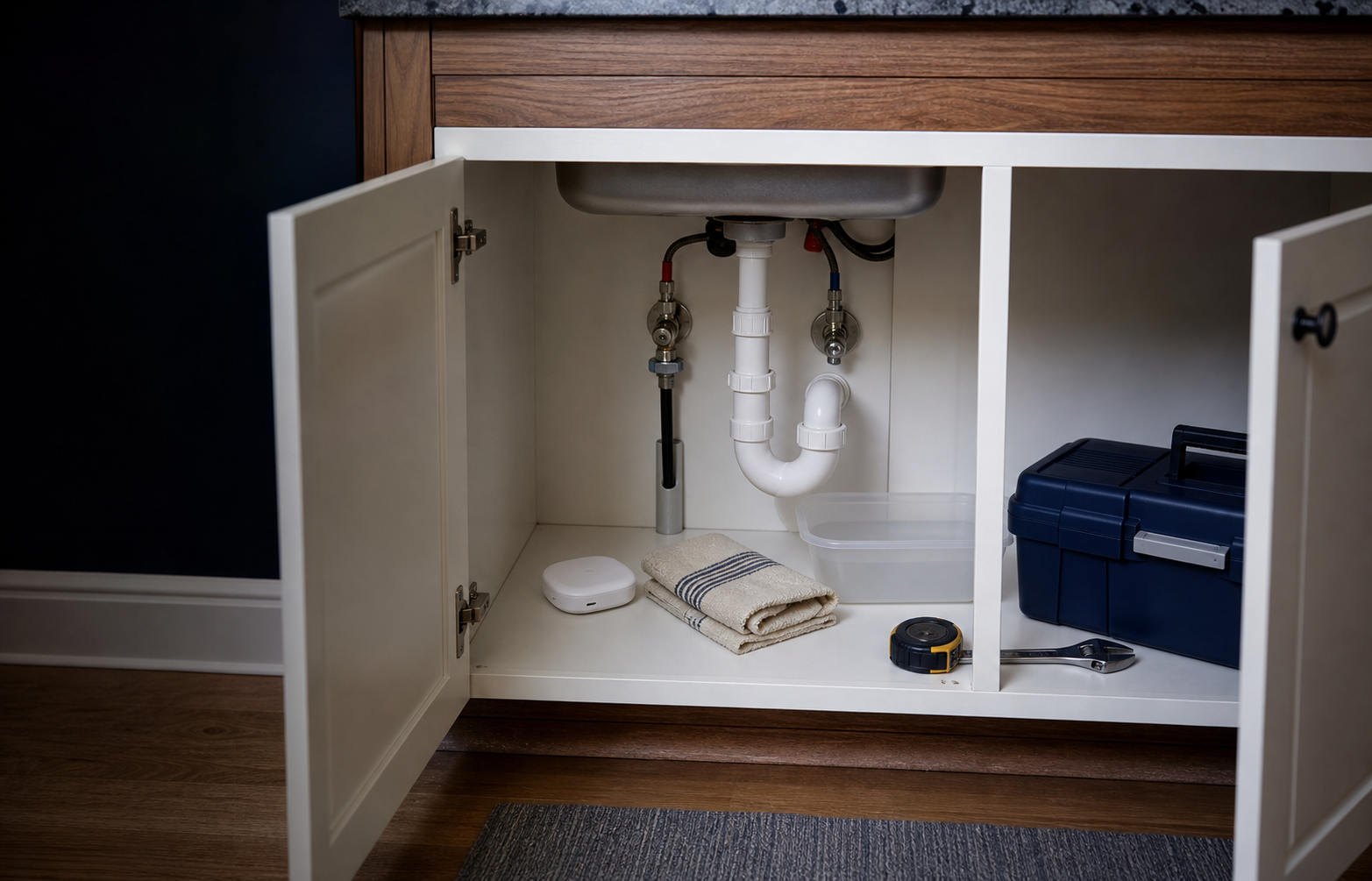

If water is dripping, pause cooking and routine filter care
Do not continue cooking beneath a hood that is dripping unexplained water or has water entering its light, controls or housing. Keep people clear and keep affected equipment out of use. If cooking heat is already on, stop it only through ordinary dry range controls that you can reach safely without crossing water, reaching beneath an unsafe ceiling or approaching fire or hot grease. Otherwise keep away and request urgent help; do not reach for a wet hood switch.
Leave immediate danger, including fire, sparking or suspected ceiling collapse, and call 911 from safety. For a gas odor or suspected gas leak, leave without operating switches or investigating; call 911 and your serving gas utility from a safe distance. Atmos Energy’s leave-first guidance is a safety reference, not a claim that it serves your home. Never pour water on a pan fire or carry a burning pan; the State Fire Marshal advises leaving and calling 911 outside whenever you are in doubt about fighting a small fire.
Request qualified electrical help for water-exposed equipment or uncertain isolation. CDC warns against operating power or equipment while standing in water, and ESFI calls for qualified evaluation before water-damaged electrical equipment is reenergized. A quiet fan, tripped device, wiped cover or dry-looking surface does not establish safe isolation or permission to use it.
Do not remove a filter or cover to look for the drip, reset a protective device, spray the hood or run the fan to dry it. Do not put towels or a catch container on an active or hot cooking surface or stand under a wet ceiling to collect water. Use the ceiling-leak response for overhead damage and the building emergency contact for shared property. Safe source control and access come before cleanup.
Report what happened without testing the hood or choosing a cause
Wolf’s U.S. condensation guidance discusses moisture from cooking and possible airflow, damper, cap or installation issues. These are possibilities for qualified assessment. Dripping after cooking does not prove harmless condensation; water during rain does not prove which roof or vent detail failed. Water can also travel from another building source.
Record timing already observed from a safe place. Do not run another pan of boiling water, operate the fan, spray an exterior cap or enter a roof space to reproduce the event. Normal cooking-condensation suggestions such as changing fan speed are not instructions for operating unexplained wet equipment. This original table helps describe the problem and coordinate contacts; it cannot diagnose it.
| Observation already available | Useful report and next contact |
|---|---|
| Water at a light, control or housing; electrical warning | Keep clear and request urgent qualified electrical assessment and safe isolation; report continuing water too. |
| Dripping noticed during or after cooking | Give the timing without declaring condensation. Manufacturer-authorized appliance or qualified ventilation service can assess the installed system after immediate hazards are addressed. |
| Dripping noticed during rain | Tell the qualified roofing/building provider about possible exterior entry and coordinate electrical help. Do not inspect or clear a roof cap yourself. |
| Water or staining also visible at the ceiling or cabinet | Use the ceiling-leak precautions and building/source service; water at the hood alone does not locate the entry point. |
| A plumbing fixture above was already operating | Report that event to the plumber/building contact without repeating it. Any safe stopping must follow the established fixture or customer-valve instructions. |
| Ducted, recirculating or convertible configuration is unknown | Use existing model/installer records and ask qualified service to confirm the actual arrangement. Do not buy a duct part or change a damper based on the product name. |
Separate the water repair, equipment decision and material follow-up
Ask the appliance or ventilation provider which source was actually found and whether a roofer, installer, plumber or building manager must handle another part. Wolf notes that hood service can require installer or contractor involvement. Specify who coordinates the handoff rather than assuming a filter cleaning or hood replacement resolves the building source.
The Broan 99042381P instructions distinguish installed hood arrangements and require appropriate power precautions before maintenance, with qualified installation and wiring. Those drawings and care instructions do not authorize investigation inside a leaking hood. Have qualified providers identify what was exposed, what work was completed, what remains out of use and whose actual instructions govern returning the hood, light and cooking equipment to use.
Keep wet ceiling, cabinet, insulation or other material work on a separate line. EPA advises correcting water problems and drying affected materials completely; major, concealed or contaminated-water damage needs appropriate experienced help. A stopped drip, dry cover, repaired vent or new filter does not by itself complete all three decisions: source correction, equipment clearance and material recovery.
The normal configuration and filter-care sections below apply only after active water and unresolved equipment or access hazards have been addressed. This guide offers no universal duct diameter, cap modification, insulation recipe, fan-speed cure or waiting period for safe reuse.
Example: drops at a hood on a rainy evening
Fictional example: a household sees water at a kitchen hood on a rainy evening, while the range is already off. It keeps people away, leaves the affected equipment unused and requests electrical and roofing/building help. Its report says “water at hood during rain; source and exposure unknown.” It does not run the fan, climb to the vent or conclude that a roof cap is the failed part.
From existing records, it provides the model and notes that the exhaust route has not been confirmed. It asks the providers to separate the confirmed entry source, electrical/appliance findings and wet-cabinet or ceiling tasks. A later stopped drip is recorded as an observation until actual repair and use instructions are documented. This invented example is a planning exercise, not a repair result or a diagnosis.
- First visible water location and time; immediate fire, gas, electrical or overhead concerns: ___.
- Cooking, rain or weather timing already observed; things still unknown: ___.
- Hood/range identity and installed exhaust arrangement from existing records: ___.
- Building, electrical, appliance/ventilation and source contacts; response and immediate instructions: ___.
- Confirmed water source, actual correction and unresolved work: ___.
- Equipment assessed; restrictions and provider’s specific return-to-use instructions: ___.
- Wet materials, responsible provider and next update: ___.
Compare a portable cleaner without changing the exhaust record
If you are also researching a portable room air cleaner, keep its particle CADR and coverage assumptions separate from the kitchen hood’s actual exhaust arrangement and filter care. The rating guide explains why a large coverage headline, a quiet fan mode and a filter-efficiency claim cannot be combined into one performance promise. A portable-unit note does not confirm that the hood exhausts outdoors or complete a pending ventilation assessment.
Start with the installed configuration
Find the exact hood model in an existing appliance record, accessible label or owner manual. For an over-the-range microwave, use that appliance’s ventilation instructions. Whirlpool distinguishes ducted, ductless and convertible arrangements; an installation option in a manual is not a record of which option was actually used.
Compare the manual with any installer paperwork or inspection record. From ordinary safe access, note visible features without removing panels or moving the appliance. If the exhaust route or termination is uncertain, record it as unknown and ask a qualified ventilation contractor to confirm it. Do not climb onto a roof, enter a tight attic or use a flame to investigate.
| Arrangement | What to confirm in your home |
|---|---|
| Ducted / outdoor exhaust | The installed duct actually reaches an appropriate outdoor termination; a fan sound or nearby grille is not the whole record. |
| Ductless / recirculating | The actual specified filter arrangement and replacement instructions; filtered air returns to the room. |
| Convertible | Which arrangement was installed and which parts/instructions apply. “Convertible” does not mean both modes are operating. |
Identify the filter before deciding to wash it
Separate the grease-filter task from any odor-filter replacement. Broan-NuTone’s support guidance distinguishes washable metal grease filters from its non-ducted carbon filters that must be replaced. Do not transfer the care method of one layer to the entire assembly.
Use the actual model manual to identify removable parts, the correct filter or part number, permitted cleaning method, drying and reinstallation. Whirlpool also directs owners to their own manual before removing or cleaning components. If the filter identity is unclear, leave the care task unresolved while obtaining manufacturer guidance; a similar-looking replacement is not a confirmed fit.
Why a universal six-month rule can be wrong
The Broan manual numbered 99042381P gives different care instructions within one document: its 40000/42000/42000D aluminum filters are washable, while the 41000 ductfree filter is not. For that 41000 filter it describes up to twelve months of normal use, with earlier replacement when noticeably dirty or discolored.
Whirlpool’s separate support page describes a non-washable charcoal filter lasting up to six months under normal use. These are manufacturer examples, not competing deadlines for your appliance. Use the applicable model and filter instructions, including condition-based replacement, rather than averaging the intervals or assuming every carbon filter is identical. No model here is a product recommendation.
Prepare for care using the actual safety instructions
This routine guidance applies only when active water and unresolved equipment, electrical or access hazards have been addressed; use the dripping response above first when they have not.
Let hot surfaces cool and read the complete care and safety sections before beginning. “Fan off” and “power safely isolated” are different requirements: the Broan manual calls for switching off power at the service panel and preventing accidental re-energizing before cleaning or servicing. Follow your own appliance’s requirements; obtain qualified help if you cannot identify or safely meet them.
Remove only the parts the owner instructions permit, using their release method. Do not spray liquid into controls, force an unfamiliar retainer or open electrical or motor assemblies to complete routine filter care. Where washing is permitted, use the specified method and let the filter dry as directed before reinstalling it. Record a damaged, missing or poorly fitting part for manufacturer or service follow-up.
Use outdoor exhaust as intended while cooking
This routine guidance applies only when active water and unresolved equipment, electrical or access hazards have been addressed; use the dripping response above first when they have not.
For a hood that vents outdoors, EPA recommends using it whenever cooking, leaving it on for 10–20 minutes afterward, using back burners when practical and routinely cleaning the grease filter. Keep those operating suggestions separate from the appliance’s own controls and maintenance instructions.
Recirculation is not outdoor exhaust. EPA discusses other or supplemental air-quality measures, including fresh outdoor air only when outdoor air quality, weather and safety permit. Consult a professional when unsure; do not treat an open window, cleaner filter or reduced odor as proof that every cooking pollutant is controlled.
Example: an unknown route stays open on the checklist
Fictional example: a new owner finds a manual labeled “convertible” and hears the hood fan run. The record says “Installed exhaust path: unknown,” rather than “Outdoor exhaust confirmed.” The owner retains the model reference and asks the installer to identify the actual arrangement and applicable filters.
The record then separates three tasks: configuration confirmed, grease-filter care completed under the manual, and any required odor filter replaced with the specified part. A booked appointment is not a completed correction. This is an invented planning example, not an inspection, airflow measurement or tested appliance.
Keep a short hood-and-filter record
Use the free homeowner checklist’s equipment and follow-up areas to point to this note. Keep the model-specific care date and unresolved ventilation question separate, so a checked cleaning box does not hide unfinished work.
- Hood or microwave model and manual reference: ___.
- Installed arrangement; evidence or person confirming it: ___.
- Grease filter and any separate odor filter / specified parts: ___.
- Permitted care method and safety preparation: ___.
- Care completed on; condition observed; next review required by instructions: ___.
- Unresolved route, fit or performance question; responsible person and next action: ___.
Know when cleaning is not the next task
Broan’s FAQ identifies duct design, dirty filters and other installation factors among possible reasons for poor performance. Persistent smoke, unexplained noise, damaged equipment or uncertain discharge needs appropriate service rather than repeated washing or a guessed larger fan. Electrical work, duct alterations and ventilation-balance questions belong with qualified help and applicable local requirements.
Treat an active fire, gas concern or alarm as an emergency, not a filter-care task. This guide does not certify airflow, diagnose indoor-air health effects, design a conversion or prescribe universal duct sizes, fan capacities or building-code rules. For recurring general moisture observations, the condensation guide offers a separate record and escalation framework.
When to call a professional
Leave and call 911 from safety for immediate fire, electrical or collapse danger. For a gas concern leave without operating switches and call 911 and the serving gas utility from safety. Water-exposed equipment or uncertain isolation needs qualified electrical help, with appliance/ventilation, roof, plumbing or building service for the confirmed source. Providers must distinguish source repair, equipment return to use and wet-material work.
Related guides
Sources
- EPA: Strategies for Improving Indoor Air Quality While Cooking — outdoor-exhaust use and conditional supplemental measures
- Whirlpool: Range Hood Maintenance — configuration, owner-manual and safe care distinctions
- Broan-NuTone: Range Hood FAQs — exhaust arrangements, filter limits and service factors
- Broan-NuTone: Filter-care support — metal grease filters versus non-ducted carbon filters
- Broan: 40000 / 41000 / 42000-family manual 99042381P — model-specific care and safety examples (PDF)
- Whirlpool: Clean or Replace Filters — non-washable charcoal-filter example; actual model instructions control
- Wolf U.S.: Ventilation Hood Condensation — possible causes and service coordination, not a diagnosis
- ESFI: Water-Damaged Electrical Equipment — qualified evaluation before power returns
- CDC: Reentering Your Flooded Home — electrical and standing-water boundary
- Texas State Fire Marshal: cooking safety — leave when in doubt, call 911 outside; no water on a pan fire
- Atmos Energy: Gas Emergency — leave first and call from safety
- EPA: Mold Cleanup in Your Home — correct the source and dry affected materials
Free next step
Download the free seasonal maintenance checklist to record observations and follow-up tasks. See the seasonal maintenance routine for more context.
Affiliate disclosure
No affiliate links appear in this guide. If a reviewed recommendation is added, the disclosure will appear beside it.