
Check the exact product's permitted load with the user, clothing, tools and materials included. Then check its intended standing surface, placement and task limits. A higher weight rating does not create more safe reach or make an awkward lift suitable.
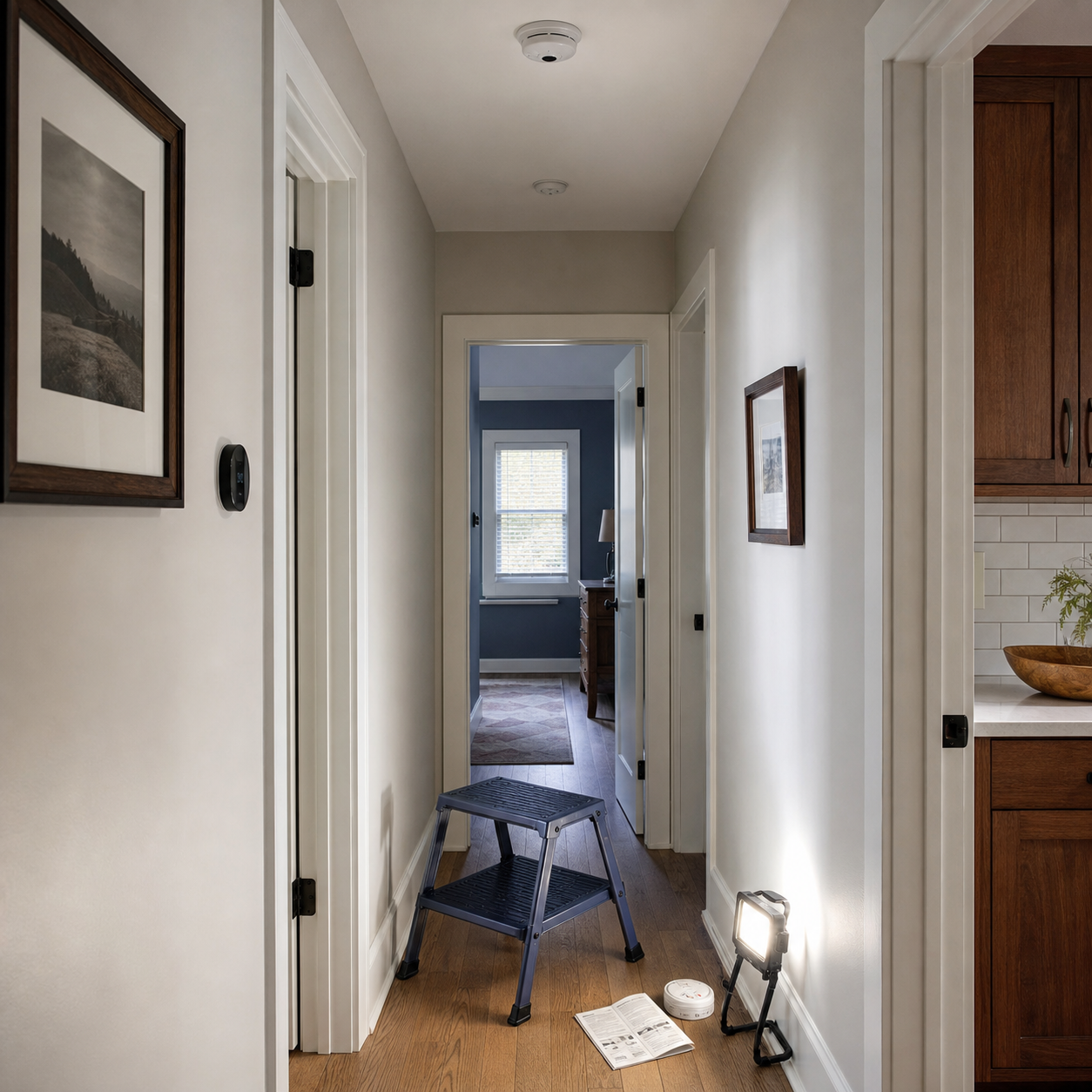

Start with the number on your actual product
Look for the model, rated load and instructions, rather than relying on a retailer's category title. A missing, damaged or unreadable label is a reason to contact the manufacturer before use. A similar-looking stool elsewhere in the home is not reliable evidence of the first one's capacity.
Some products use familiar ladder duty-type markings. The American Ladder Institute's explanation published by ANSI lists the following categories. Use them to interpret a marking when present, not to assign an unmarked household stool a rating.
Manufacturer instructions remain necessary even when the type is familiar. Do not infer a product's material, suitability, stability or standing height from the type alone.
| Marked duty type | Listed load capacity |
|---|---|
| III | 200 lb |
| II | 225 lb |
| I | 250 lb |
| IA | 300 lb |
| IAA | 375 lb |
Add the things that go up with you
The combined load matters. OSHA's workplace guidance explicitly includes the user, tools, equipment and materials in the intended load. Its rules address workplaces; this guide uses the principle to help homeowners read product instructions, not to declare legal requirements for every home.
Here is a fictional planning example:
| Item | Example weight |
|---|---|
| User | 210 lb |
| Clothing and footwear | 10 lb |
| Items being handled | 15 lb |
| Combined | 235 lb |
What the example does and does not establish
That exceeds a 225-pound marked capacity. Being below a 250-pound capacity would answer only the weight comparison, not the whole safety decision. Do not use this example as a recommendation to carry that load while climbing.
Keep each amount separate: if the user's measured weight already includes the clothing and footwear, do not add those items twice. Do not subtract a tool's weight because you expect to hold it rather than rest it on the step.
Capacity, reach and standing surface answer different questions
A taller ladder is not automatically rated for a heavier load. A stronger stool does not necessarily put your hands at a comfortable working height. A broad-looking upper surface is not automatically a permitted place to stand.
Ordinary stepladder top caps and purpose-designed standing platforms are different. OSHA's clarification discusses that distinction; your product's actual labels and instructions identify its usable surfaces. Do not solve a reach problem by stepping above the stated standing limit.
If you must stretch sideways, balance on toes, or support a heavy item away from your body, stop. Moving an item to a lower storage location or asking for help may be more appropriate than buying a taller product.
Make a label-reading note before shopping
This small worksheet separates the questions that a large capacity number can hide:
For a fictional cupboard task, a product might meet the weight comparison but still leave the user reaching sideways around an open door. The unresolved problem is position and access, not a reason to choose an even higher load rating. Change the plan or arrange help before using the product.
If a marking is unclear, give the manufacturer the exact model and ask which surfaces are intended for standing. A marketing phrase such as “three-step” cannot answer that question by itself. The ALI's stepladder guidance also distinguishes inspection and placement from the weight calculation.
| Question | Information to write down |
|---|---|
| What is the exact product? | Brand, model and where its instructions are kept |
| What does its load label actually say? | Capacity and any marked duty type, copied without guessing |
| What load have I counted? | User plus separate clothing, tools and materials; avoid double counting |
| Where may I stand? | The permitted step or platform identified by this product's instructions |
| Does the open product fit the room? | Footprint, floor conditions, door clearance and access |
Do the room check before the climb
Check the product in its intended open and locked position on a floor that meets its instructions. Account for opening doors, loose rugs, clutter and people moving through the area. Folding compactly for storage says little about the space it needs in use.
Inspect for damage and contamination as directed. Do not improvise a repair to a locking part, use a damaged stool, stack it on furniture, or move it while occupied. Your own balance, grip, mobility and footwear also matter; a capacity label cannot assess them.
This guide is limited to understanding labels for ordinary indoor decisions. It does not cover roof access, exterior ladder setup, electrical work, stairs or lifting awkward appliances.
When to call a professional
Stop and contact a qualified professional when the task requires roof access, unstable footing, work near electrical equipment, or a height that an ordinary indoor step stool cannot safely reach.
Related guides
Sources
Free next step
Download the free seasonal maintenance checklist to record observations and follow-up tasks. See the seasonal maintenance routine for more context.
Affiliate disclosure
No affiliate links appear in this guide. If a reviewed recommendation is added, the disclosure will appear beside it.