
Keep people away from wet electrical equipment and the slippery area. Stop the dishwasher through its model’s instructions only if the controls can be reached safely. For a continuing leak, isolate its known water and power supplies only through established, safely accessible controls; get urgent help if that is not possible. Leave it out of use and contact manufacturer support or a qualified appliance technician. A reset, dry floor or cleaned filter does not establish that the leak is repaired. For a portable model, identify its faucet connection separately; do not release a coupling as a shortcut to stopping water. Water escaping from an identified countertop dishwasher air gap needs a drain-side plumbing report.
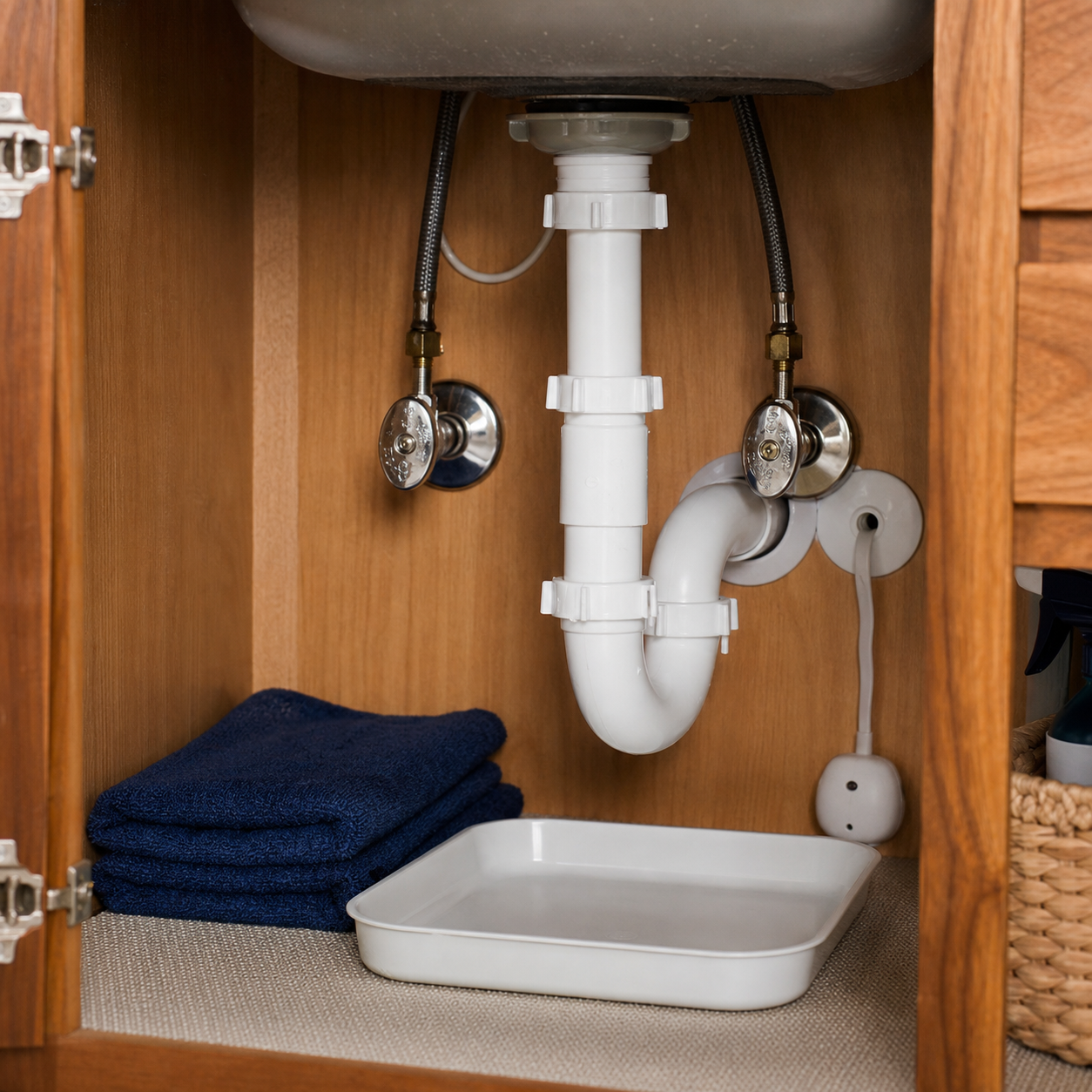

First: keep people safe and stop adding water
Keep children and pets clear. Do not step into water to reach a breaker, unplug a wet cord or touch a wet switch or appliance. CDC’s flooded-home guidance prohibits operating power or electrical equipment while standing in water. Apply that boundary to a kitchen leak too. For immediate danger, injury, fire or suspected collapse, leave the affected area and call 911.
If you can safely reach the ordinary controls, follow the actual model’s instructions for stopping. Do not throw open a hot dishwasher to investigate: hot water and steam can escape. If the safe stopping method is unclear, seek manufacturer or urgent qualified help rather than trying button combinations.
Whirlpool’s leak support advises stopping power and water for a continuing leak and keeping the appliance out of use until the source is fixed. Use only the already identified supply controls, with safe dry access and understood instructions. Do not pull out the installed appliance, open a panel or reach behind wet equipment. If isolation is unsafe or unknown, ask the building emergency contact, plumber or electrician to make it safe.
Use the known water control, not an unfamiliar valve
The appliance supply may be near other plumbing or electrical equipment. Its location alone does not identify it. Close a known appliance shutoff only when you are authorized, its instructions are understood and access is safe. Do not force a stuck or corroded valve, loosen a hose or move a disposal cord to reach it.
If the appliance supply cannot be safely isolated and water continues, the home’s known customer shutoff may be the appropriate control under your established household or utility instructions. Do not guess at a shared-building, utility or fire-sprinkler control. Ask qualified help when uncertain. Stopping the water is damage limitation; the source still needs assessment and repair.
Who should handle the next step?
Describe the hazard and whether water is still escaping before asking about parts. A puddle at the door is not enough to identify a failed seal, hose or pump. Whirlpool lists several possible causes; the useful first message is what happened, not a guessed diagnosis.
| Situation | Useful next contact |
|---|---|
| Water at an already-identified countertop dishwasher air gap | Qualified plumber for the drain-side arrangement; coordinate with appliance service if the source is uncertain or also involves the appliance. |
| Leak seems tied to the dishwasher; safe isolation established | Manufacturer support or qualified appliance technician. Give the full model, symptom and any message. |
| Known supply valve or house plumbing leaks, or flow cannot be stopped | Urgent plumber; building emergency contact for shared systems or access. |
| Water at electrical equipment or unsafe access to power | Keep clear and obtain urgent electrician or emergency help. Do not touch or test wet equipment. |
| Water appears on a ceiling below the kitchen | Keep people away from the wet ceiling and fittings; follow the ceiling-leak response and notify the building contact. |
| Wet flooring, cabinetry or suspected contaminated water | Arrange appropriate water-damage assessment; keep cleanup separate from appliance repair. |
Water at a countertop air gap needs a drain-side report
If water was already seen escaping from a known dishwasher air gap on the sink or counter, report that location to a qualified plumber. GE describes this fitting as drain plumbing that helps prevent backflow into the dishwasher. Oatey distinguishes the dishwasher-to-air-gap inlet from a separate outlet connection to the disposal or drain tailpiece. Escaped water there does not by itself identify a failed dishwasher pump, door seal or faucet cartridge.
Keep the dishwasher out of ordinary use and follow the safe stopping boundaries above. A control action may include draining; a closed supply handle does not establish that discharge has ended. Do not select a cancel or drain program to investigate. Get urgent qualified help if water continues or safe controls are uncertain.
Not every installation has a separate countertop dishwasher air gap. A reverse-osmosis drinking-water faucet may have its own air-gap arrangement, and a portable dishwasher may discharge into the sink through a different connection. Use existing installation records or ask the provider to identify the fitting. Do not trace hoses through a wet cabinet, remove a cover, seal an opening, reroute a hose or run the disposal to find out.
GE publishes routine air-gap cleaning instructions, but those do not establish safe access or explain an unidentified active overflow. Ask the plumber which drain-side path and connections require assessment; involve appliance service when the source also involves the dishwasher or remains uncertain. Have the provider confirm the installed arrangement and local requirements.
| Already observed condition | Useful question for the provider |
|---|---|
| Water at the identified air-gap opening | Which drain-side path or connection caused escaped water, and who will correct it? |
| The sink looked empty when overflow was noticed | What assessment confirms the dishwasher discharge path? The visible basin alone does not clear that path. |
| Recent sink, disposal or dishwasher installation work | Which work and connection records should the plumber review? Timing alone does not identify a blockage or installation error. |
| Water also reached the cabinet or floor | Who checks separate connections and affected materials, alongside any electrical assessment? |
| Water stopped when the cycle ended | What source finding, completed correction and specific reuse instructions remain before closing the leak report? |
Example: the counter fitting overflowed but the sink looked empty
Fictional example: a household sees water at an already-identified dishwasher air gap during a cycle. From a dry location, the sink basin looks empty. The household follows its known safe stopping instructions and requests urgent help if water continues or access is unsafe. It does not start a drain cycle or run the sink to test its conclusion.
The call says “water escaped at the dishwasher air gap; the sink looked empty; recent disposal work is in our records.” The plumber is asked to establish the actual drain-side cause and coordinate with appliance service if needed. A stopped overflow does not close the repair, wet-cabinet or electrical tasks. This example illustrates a service handoff, not a diagnosis or permission to clean, bypass or restart the installation.
- Fitting identity from existing records, or still unknown: ___.
- First opening or location already seen; sink condition at that time: ___.
- Recent sink, disposal or appliance work and provider details: ___.
- Who will establish the drain-side finding and any separate appliance finding: ___.
- Completed source work, specific reuse instructions and remaining material/electrical follow-up: ___.
A cancel button or error reset is not a leak repair
Controls differ. Bosch’s SHXM63WS5N manual, document 9001238307_B, separates normal shutdown, interruption and a cancel operation that includes draining. It also warns about hot water, steam and pressure when opening the door. That is a model-specific illustration of why a generic “hold Start” tip is not a universal leak-response instruction.
Bosch’s U.S. support list describes E15 and E3100 as water detected in the base with leakage protection activated. For those entries it advises stopping water inflow and contacting Bosch support. Those meanings are brand and code specific; they do not identify the failed part or establish that every model uses those codes.
Record the exact displayed message if visible safely. Do not borrow breaker-reset instructions from a different error, tilt the appliance to empty its base, bypass leak protection or run repeated cycles to see whether an alarm returns. A cleared display does not confirm a repaired source.
Useful owner observations after the immediate hazard is controlled
Use records and what you already saw. Note when water first appeared, whether the dishwasher was running and whether a sink or other fixture was also being used. Do not run the sink or dishwasher again to reproduce the symptom. Do not reach underneath the unit to track a drip.
Once the appliance is safely stopped and cooled, check the owner documentation for any permitted visual check. Wrong detergent, excess suds or an obstructed closing area are useful facts to report, not permission to add a home remedy, adjust leveling feet or replace a seal without applicable instructions. Keep the detergent package or its name for support.
Use the full model and suffix from existing records first. If identifying the label would require opening a hot appliance, entering water or moving the unit, ask service to identify it. Filter designs also differ: use the separate filter-care guide for routine maintenance after the leak issue and safe-use conditions are resolved.
Copy this short service-call note
Call promptly for continuing water or unsafe conditions; the note can be completed afterward. Keep photos, model identifiers and contact details in your own household records.
- Address, affected area and immediate hazards: ___.
- Started at ___; cycle or other water use already happening: ___.
- Where water was first visible, without moving the appliance: ___.
- Full model/suffix and exact message, if safely available: ___.
- Detergent or rinse-aid product recently used; suds already observed: ___.
- Known controls or supply shutoffs used, by whom and when; whether water continues: ___.
- Repair contact, case number, next visit and instructions for keeping the appliance out of use: ___.
- Separate wet-material assessment and who will confirm conditions for using the appliance again: ___.
Example: a puddle at the front after starting a wash
Fictional example: a household notices a puddle near the dishwasher door after a wash begins. They keep people out of the wet area and follow their known safe stopping and isolation instructions. From a dry place, they call support with the model record and say when and where water appeared. If they had used a different detergent, they report its name.
They do not conclude that the door seal failed, pour in an additive or run another cycle as a test. If the power control cannot be reached safely, qualified help takes over. The example shows a useful handoff; it does not diagnose the appliance or promise a particular repair.
Finish both the source repair and the wet-material follow-up
Only place a towel or shallow container where the area is safe, without approaching wet electrical equipment or standing below damaged material. Do not plug in a wet vacuum, fan or dehumidifier before electrical safety and the water’s condition are established. A dry floor does not show what happened beneath cabinets or flooring.
EPA recommends fixing water problems promptly and drying water-damaged materials within 24–48 hours to help prevent mold. Arrange timely assessment; that interval is not a safe waiting period or a guarantee that hidden materials are dry. Significant water damage, suspected contamination or uncertain concealed wet areas call for appropriate qualified help.
Ask separately who will repair the source, assess affected materials and provide instructions for returning the appliance to service. Record the result and unresolved tasks on the free homeowner checklist. An alarm reset, emptied tray or completed filter cleaning should not close an unresolved leak entry.
Keep a wet disposal connection in the same service report
If water was already seen near a disposal or its dishwasher connection, report that location without running either appliance again. Water can travel before its first visible drip, so the observation does not prove that the dishwasher itself failed. Keep the wet electrical area clear and do not tighten a hose clamp or move the disposal for a better look.
The under-sink guide now includes disposal source distinctions and a repair/service/replacement question table. Ask the appliance provider and plumber who assesses the actual connection and what work remains separate, including wet cabinetry. Use the exact model and completed findings before choosing parts or a replacement.
A portable dishwasher has a separate faucet-connection question
If the dishwasher connects temporarily to a sink faucet, report that arrangement before asking about an appliance part. Keep clear of hot discharge, wet plugs and controls. Stop continuing feed only through the actual model’s known, safely reachable water control under its established instructions; get urgent help if access or operation is uncertain. Do not pull off the faucet coupling to stop an active leak.
GE’s current GPT225SSLSS gateway links owner manual 49-4000275 Rev 3, dated 09-26. Its portable-only section distinguishes water entering through one hose from discharge returning to the sink through another. Its normal disconnect instructions separately address the hot-water feed and retained coupling pressure. Those are different conditions; this is not a universal emergency disconnection sequence.
Describe the first location already seen: the faucet attachment, the faucet’s own body, a hose, water missing the basin or the appliance housing. Intended discharge reaching a sink is not the same observation as water escaping onto the counter or floor. A basin that cannot drain needs its own plumbing response; do not run the disposal or another wash to investigate.
The same manual includes adapter compatibility and a caution about an attached sink spray hose. Have the actual faucet, adapter and dishwasher arrangement assessed rather than tightening fittings, changing the faucet or borrowing another model’s coupling procedure. Manufacturer setup and normal storage instructions do not clear an unidentified hot, pressurized or electrically exposed installation.
| Already known location or condition | Next question or contact |
|---|---|
| Water at the faucet attachment | Appliance support and a plumber as appropriate: who confirms the matching adapter, connection and safe stopping instructions? |
| Water at the faucet’s own body or base | Ask a qualified plumber to assess the fixture separately from the dishwasher. Do not force or dismantle it. |
| Discharge misses the basin or the sink is backing up | Keep ordinary use stopped. Ask who resolves the actual discharge arrangement and household drainage. |
| A hose, appliance housing or uncertain starting point | Give qualified appliance service the model and existing observations without moving the unit or repeating a cycle. |
| Wet power, hot spray or unsafe access | Keep clear and request urgent qualified electrical, plumbing or emergency help as the hazard requires. |
Example: water appears where a portable dishwasher meets the sink
Fictional example: a household notices water at the counter during a portable dishwasher cycle. It stops ordinary use under its known safe instructions and closes the already identified water feed only when access and operation are safe. If hot spray or wet power prevents that, urgent qualified help takes over.
The report says “portable dishwasher attached to sink; first water seen near the faucet; exact source unknown.” The household does not press a release collar, tighten an adapter or run the appliance again to identify the leak. It gives support existing model and faucet records and asks whether appliance service, a plumber or both should assess the connection.
Its follow-up keeps the provider’s source finding, completed work, safe connection/use instructions and any electrical or wet-cabinet work separate. This invented example illustrates a useful handoff; it does not diagnose a coupling, approve an adapter or establish a restart procedure.
- Portable model/suffix and faucet/adapter details already available: ___.
- First water location; feed, discharge or source still uncertain: ___.
- Known safe stopping actions already taken, without disconnecting or testing: ___.
- Provider responsible for appliance, faucet/connection and drainage findings: ___.
- Completed repair, specific reuse instructions and separate electrical/material tasks: ___.
When to call a professional
Leave a dishwasher with an unresolved leak out of use and contact its manufacturer or qualified appliance service. Request urgent plumbing or building help for continuing supply or drainage water, and qualified electrical help for wet power or unsafe access. For a portable model, report the actual faucet and coupling arrangement without disconnecting it to test. Keep wet-material work and specific return-to-use instructions separate. Identify countertop dishwasher-air-gap overflow separately for the plumber; an RO faucet air gap is a different arrangement.
Related guides
Sources
- Whirlpool: Dishwasher Leaking Troubleshooting Guide — escaped-water response and service
- Bosch SHXM63WS5N: Operating instructions 9001238307_B — model-specific isolation, hot-door and cancel/drain cautions (PDF, pages 8, 31–32)
- Bosch U.S.: Dishwasher Error Codes — E15 and E3100 leakage-protection entries
- CDC: Reentering Your Flooded Home — electrical safety boundaries
- EPA: A Brief Guide to Mold, Moisture and Your Home — source repair and prompt drying
- InSinkErator US: Garbage Disposal Leaking — source distinctions and support referrals
- Moen: Leak Around Middle, Existing Garbage Disposal — existing-unit scope and water traveling from above
- Whirlaway: INS10663, January 2018 — safety page 2 and troubleshooting page 14; product-specific illustration
- GE Appliances: GPT225SSLSS owner gateway — actual portable-model documentation and support
- GE: Owner manual 49-4000275 Rev 3, 09-26 — model limits, safety and portable faucet connection (pages 3–6, 11–12, 16–17, 20)
- GE Appliances: Water Leaks From the Air Gap — drain-plumbing role and plumber referral
- Oatey: What is an Air Gap product? — dishwasher inlet and separate drain-side connection
- GE Appliances: Leaks or Floods Underneath — plumbing and appliance-service distinction
Free next step
Download the free seasonal maintenance checklist to record observations and follow-up tasks. See the seasonal maintenance routine for more context.
Affiliate disclosure
No affiliate links appear in this guide. If a reviewed recommendation is added, the disclosure will appear beside it.