
Check the exact dishwasher’s owner instructions before trying to remove a filter. Some systems have an owner-cleaned filter assembly; others describe maintenance-free filtration with a separate foreign-object cup. A cleaning cycle is another task. Match the instructions to your model and installed parts, then record the permitted care and correct reassembly. Do not force a part because another dishwasher’s filter twists out.
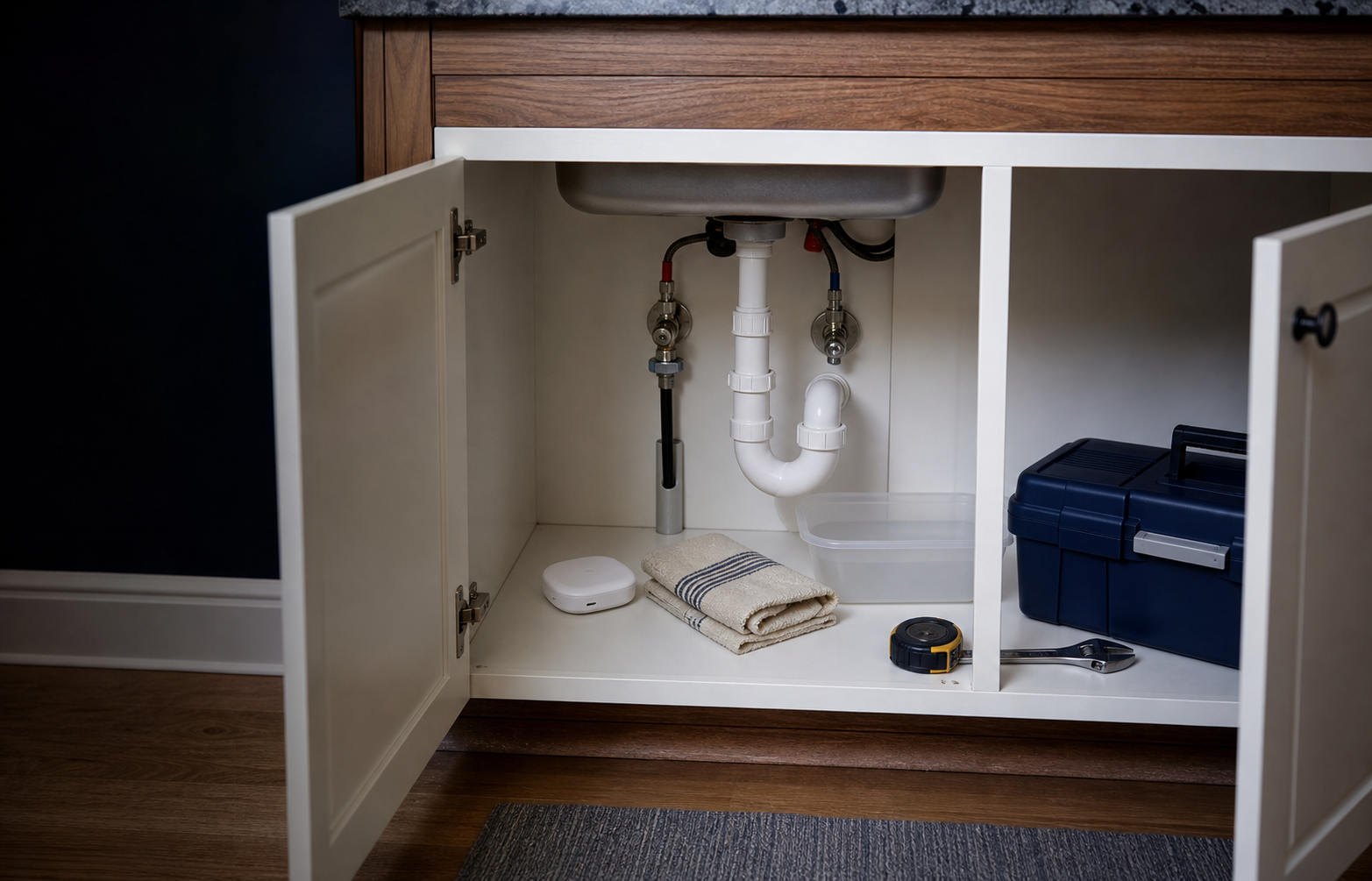

Escaped floor water takes priority over filter care
If water is escaping onto the floor, stop treating the situation as a routine cleaning reminder. Keep clear of wet electrical equipment and use only safe, understood stopping and isolation controls. Leave the appliance out of use and contact manufacturer support or a qualified technician. Filter removal, a cleaning cycle or an error reset does not establish that the leak source is fixed.
The dishwasher floor-leak guide separates safe stopping, supply uncertainty and the right repair contact. It includes a service-call record for the model, message, timing and actions already taken. Return to ordinary filter care only when the leak and the conditions for safe appliance use have been resolved.
Find the model before choosing a cleaning method
Use the full model identifier from an existing appliance record or safely accessible label, including its suffix when present. Retrieve the manufacturer’s owner documentation, not just a video of a similar-looking tub. Whirlpool’s official manual finder is one example of a model-number lookup; Bosch’s filter-care support also directs owners to their actual manual.
Open the care section and identify the named parts in its diagram. Keep the document reference with the model. If the part arrangement or instructions do not match, ask manufacturer support to resolve the difference before removing anything. “Filter not yet identified” is a useful record; a guessed removal method is not.
Separate three different care tasks
Whirlpool’s support page describes both an owner-cleaned filter style and another style with maintenance-free filtration plus a foreign-object cup. Its separate interior-cleaning advice does not make every filter removable. Use these distinctions to find the applicable instructions, rather than treating all components as one cleaning job.
| What the instructions describe | What to establish before acting |
|---|---|
| Owner-cleaned removable filter assembly | Permitted removal, cleaning, inspection and locking/reassembly method for the actual model. |
| Maintenance-free filtration with a foreign-object cup | Whether a separate cup needs attention under those instructions; do not dismantle the filtration system by analogy. |
| Interior cleaning / cleaning cycle | The approved product and cycle instructions; this does not establish that removable-filter care was completed. |
| Unclear system or a part that does not match | Retain the model and observed mismatch for manufacturer support; leave removal unresolved. |
Read the applicable example, not a universal schedule
Bosch’s operating instructions for SHXM63WS5N, document 9001238307_B, describe a three-part filter system. Its care section ties maintenance to use and water hardness, cautions that debris can be sharp, specifies rinsing without abrasive brushes or steel wool, and requires the assembly to be locked with its marking arrows aligned. Those are instructions for that appliance, not every Bosch or every dishwasher.
Maytag’s guide W11680100C illustrates a different arrangement: maintenance-free filtration with a separate foreign-object cup. The guide describes attending to the cup if it fills with particles or objects. It is a document-specific contrast, not confirmation that any particular Maytag model in your home uses it. Verify applicability through your own model’s documentation.
A monthly household reminder can prompt an instructions check, but it is not a universal monthly filter-washing rule. Record the interval and condition triggers from the actual manual. No appliance named here is a recommendation or a firsthand test.
Prepare for owner care and stop at an unsafe mismatch
Read the complete safety and care instructions first, including the required stopped/cooled condition, power precautions and permitted access. Do not begin during a running or hot cycle. Keep children away from an open appliance and do not put body weight on its door. If you cannot safely reach or identify the permitted part, obtain help.
Debris can include sharp fragments. Do not feel blindly in the filter area or reach into an unseen opening. Retain a broken-glass or sharp-object concern for appropriate manufacturer or qualified-service advice. Routine owner care does not require inventing a way to remove a fixed cover, pump, wiring panel or the dishwasher itself.
For a removable assembly, follow its release, cleaning and inspection directions exactly. Check for damage and reinstall/lock all required parts as the manual specifies before operating again. If a part will not seat or lock, stop and resolve that fit; do not use a wash cycle to test an incomplete reassembly.
Keep a cleaning result separate from a repair result
Cleaning a permitted removable filter may complete that maintenance task. It does not diagnose why dishes remain gritty, why water will not drain or why an alarm sounded. Record the symptom, cycle and any displayed message separately, and use the model’s troubleshooting or qualified service when the issue persists.
Bosch’s SHXM63WS5N manual treats drain-pump work in a separate section from filter care, with additional precautions. This guide stops at ordinary owner care; it does not provide a pump-opening or standing-water repair sequence. If water escapes onto the floor, use the leak-response guidance rather than assuming another cleaning cycle will fix it.
Example: identify the system before checking the box
Fictional example: a homeowner’s monthly list says “clean dishwasher filter,” but the found manual describes maintenance-free filtration and a separate debris cup. The record is changed to “Verify applicable cup-care instructions,” with the full model and manual reference. The owner does not force an unfamiliar screen to match a removable-filter video.
After any permitted care, the record states what was completed and whether all required parts were correctly refitted. A remaining drainage symptom stays open as a separate service question. This is an invented planning example, not an appliance inspection, repair outcome or measured cleaning result.
Copy this short dishwasher-care record
Use the free homeowner checklist’s equipment and follow-up spaces to point to this note. A floor leak sensor and a filter-care entry serve different purposes: neither completes the other.
- Full model/suffix and applicable owner-document reference: ___.
- Filtration system and owner-removable part names: ___.
- Required safety preparation and approved care method: ___.
- Interval or condition trigger stated by the actual instructions: ___.
- Date and exact care completed; damage or unusual debris observed: ___.
- Required parts refitted/locked as instructed; any unresolved fit: ___.
- Separate symptom or service question, responsible person and next action: ___.
When to call a professional
Stop and contact a qualified professional if the work involves electrical wiring, gas, structural damage, roof access, major plumbing changes, mold, lead, asbestos, or another hazardous material.
Related guides
Sources
- Whirlpool: Dishwasher Leaking Troubleshooting Guide — escaped-water response and service
- Whirlpool: Cleaning the Filter — different removable-filter and maintenance-free/cup styles
- Whirlpool: Official appliance manual finder — use the full model identifier
- Bosch: Dishwasher filter care — actual owner manual controls removal
- Bosch SHXM63WS5N: Operating instructions 9001238307_B — filters, sharp-debris warning and locking (PDF, pages 33–35)
- Maytag: Quick Start Guide W11680100C — maintenance-free filtration and separate foreign-object cup example (PDF)
Free next step
Download the free seasonal maintenance checklist to record observations and follow-up tasks. See the seasonal maintenance routine for more context.
Affiliate disclosure
No affiliate links appear in this guide. If a reviewed recommendation is added, the disclosure will appear beside it.