
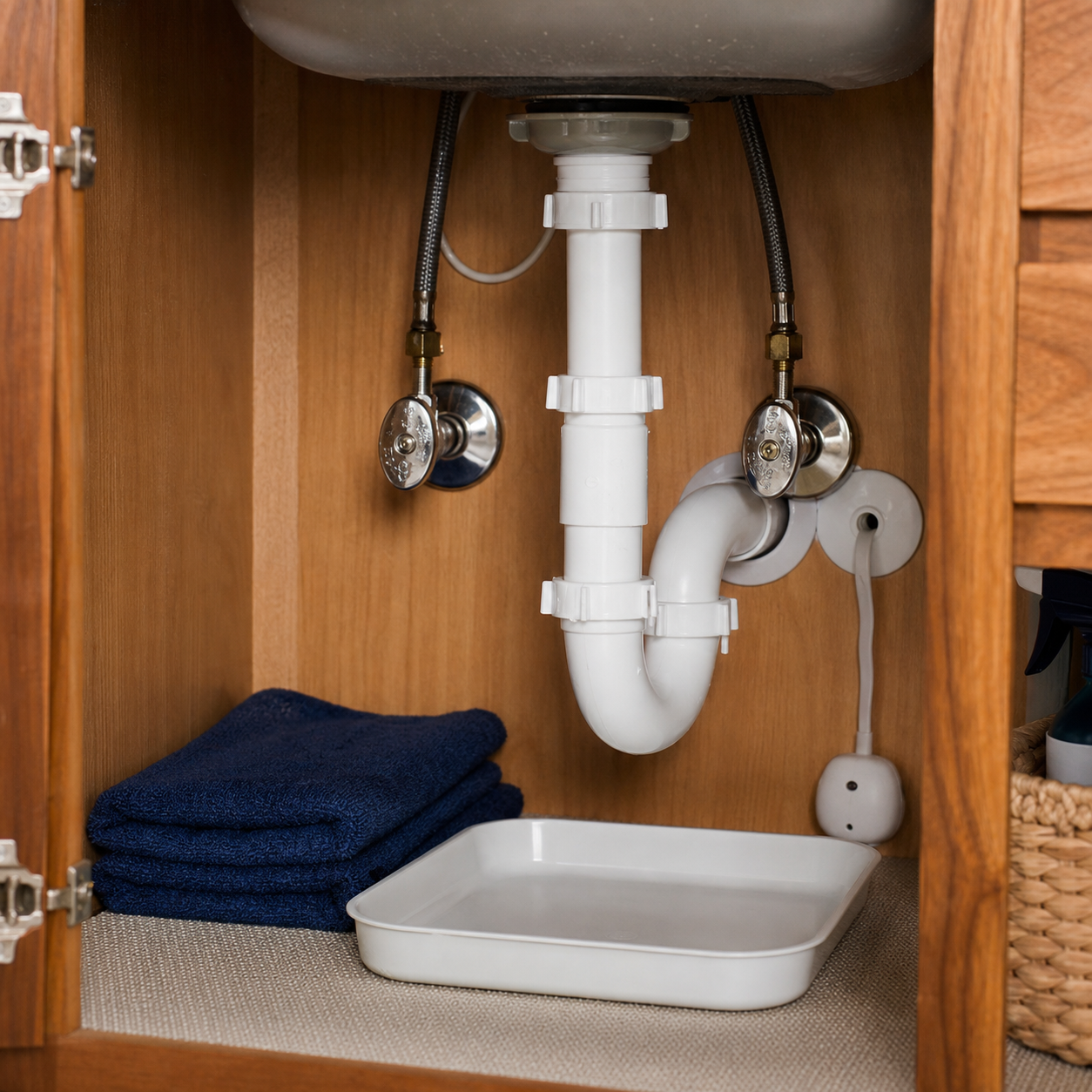
A spot sensor detects water at its contacts. A sensing cable detects moisture along the portions designed to sense it. A wire connecting a remote probe may only carry a signal. Identify the actual sensing part, then check whether water can reach it in your intended location.

Start with the part that gets wet
The shape of an accessory can be misleading. A small detector may have contacts underneath its body. A remote disc can move those contacts away from the main unit. A sensing cable can provide a longer sensing line. The connecting cord and the sensing element are not automatically the same thing.
Moen’s separately sold 920-006 is a documented example: its specification sheet describes moisture detection along the cable and compatibility with the 920-004 detector. That establishes the function of that accessory, not a rule for every alarm with a cord. The sheet is dated September 2020; confirm the instructions supplied with the exact product before choosing extensions.
| Arrangement | Where detection happens | Question to ask |
|---|---|---|
| Contacts under a detector | At the device’s sensing contacts | Will escaped water reach the underside at this placement? |
| Remote disc or probe | At the documented probe contacts | Does the connecting section sense anything, or only carry the signal? |
| Moisture-sensing cable | Along its specified sensing portion | Which parts sense water, and what routing and extension limits apply? |
| Several independent detectors | At each detector’s contacts | Can every location be named, reached, tested and maintained? |
Draw a coverage sketch in five minutes
For a dry, accessible location, sketch the floor area and mark fixed dividers, raised edges and places you cannot reach. Mark the proposed sensing parts separately from ordinary connecting wire. This is a planning sketch, not a prediction of every path a leak could take.
Now ask where water would need to travel to reach those parts. A tray lip or a divider may separate two areas that look close together. A cable can follow a line around an obstacle, but its length is not the square footage it monitors. EPA distinguishes local moisture detection from flow monitoring; neither the app’s room name nor the length of a cord proves whole-room coverage.
- Mark the exact monitored compartment or surface.
- Identify sensing contacts, sensing cable and ordinary connecting wire separately.
- Note service access and places the manufacturer does not permit.
- Write down who receives the alert and who can respond.
- Leave an unresolved placement question for the manufacturer or an appropriate professional.
A divided sink cabinet: a worked example
Imagine a fictional cabinet with a solid divider and a dry compartment on either side. A detector in the left compartment does not also monitor the right one just because both sit beneath the same sink. The divider makes the assumption visible: water on the right might never touch the left-hand contacts.
One option to investigate is a second independent detector. Another is a compatible remote probe in the second compartment. A documented sensing cable may be suitable for a different route. Compare these arrangements against the exact instructions, accessibility and notification setup; this example does not select a product or guarantee which way water will run.
Compare the whole arrangement before buying
Record the detector model and accessory model together. Check connector compatibility, the supported sensing area, permitted surfaces, cleaning instructions, power source and any required hub or network. A plug that looks right is not proof of compatibility.
Check extension limits in the current instructions. The 920-006 sheet uses different wording about additional cables and total length, so this guide deliberately does not turn that into a universal maximum. Ask support to resolve an unclear limit before ordering or connecting accessories.
Finally, separate detection from notification and action. Sensing cable does not by itself add smartphone alerts, make a siren audible in another room, or operate a water valve. Choose an alert path that somebody can act on.
Questions worth settling before installation
Does every inch of the cord detect water? Only if the exact documentation says so. A remote probe’s lead can look similar to a sensing cable while serving a different purpose.
Is more cable always better? A useful route, reachable checks and a clear response plan matter more than unused length. Avoid obstructing drains, vents, doorways or service access.
How should I test it? Use only the manufacturer’s approved procedure for that detector and accessory. Do not create a plumbing leak to test the sketch. Recheck placement after moving the detector or changing nearby storage.
When to call a professional
Stop and contact a qualified plumber or other appropriate professional if water is actively spreading, you cannot safely find the shutoff, the leak involves a wall or ceiling, or a repair would require changing plumbing.
Related guides
Sources
Free next step
Download the free seasonal maintenance checklist to record observations and follow-up tasks. See the seasonal maintenance routine for more context.
Affiliate disclosure
No affiliate links appear in this guide. If a reviewed recommendation is added, the disclosure will appear beside it.