
Choose a local audible alarm when a person is likely to hear it and respond. Consider remote notifications when the home is often empty or the sensor is difficult to hear. Many connected detectors have both features. Confirm the exact model's local operation, connection requirements and support status before buying.
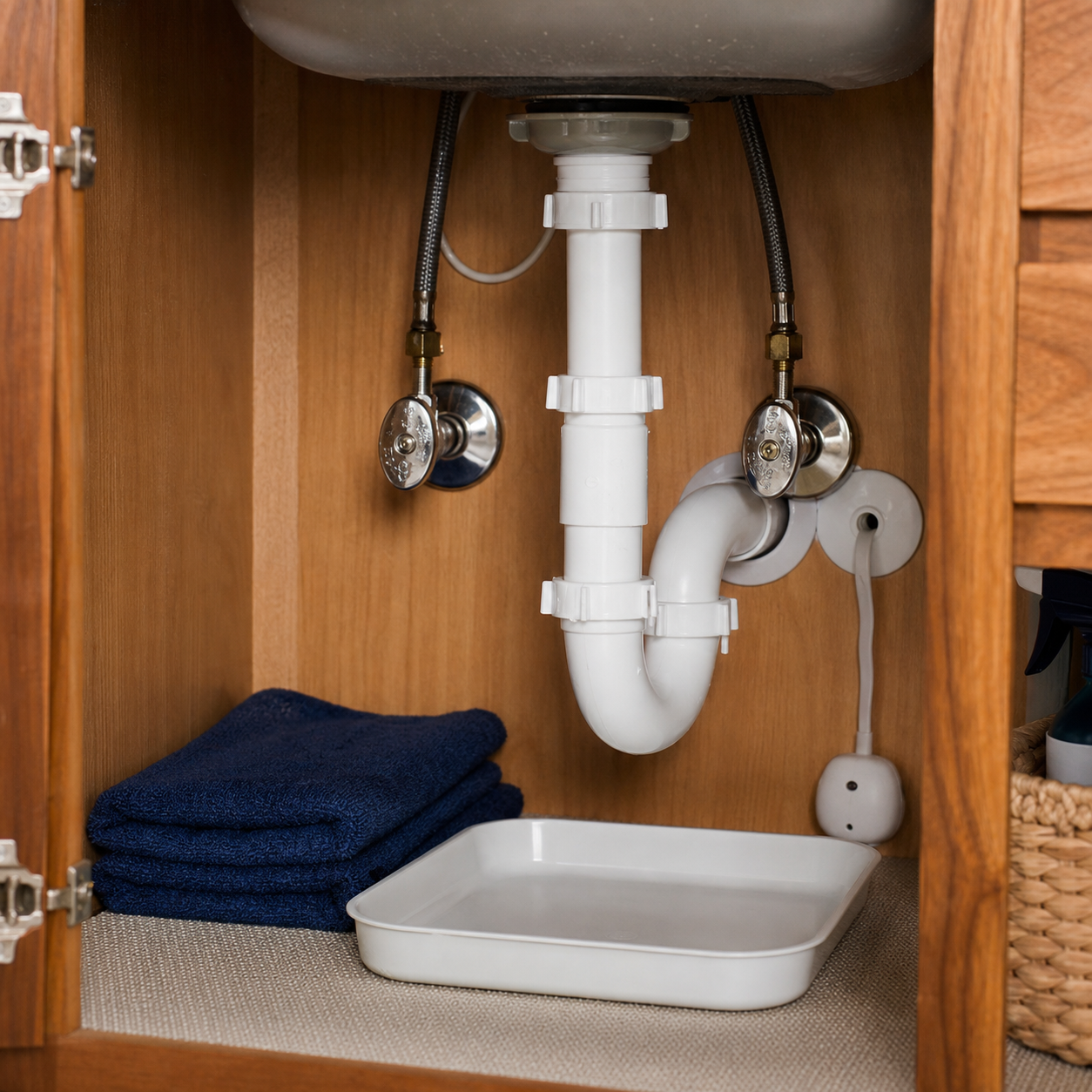

The alert path matters more than the label
A moisture detector notices water at its sensing elements. How that information reaches you is a separate question. EPA distinguishes moisture sensing from devices that monitor water flow; neither term alone tells you whether an alert is local, remote, or paired with a shutoff.
A basic audible unit avoids an app setup but still needs its specified power source and correct placement. The Basement Watchdog BWD-HWA is one manufacturer example of a local water alarm with a remote sensing probe on a wire. That wire is not a promise of smartphone alerts.
For comparison, Moen's Flo Detector setup requires an account, app and local Wi-Fi pairing. Its optional connection to a separate Flo Shutoff is an additional capability; the standalone detector is not itself a water valve. These examples illustrate different arrangements, not product recommendations.
Match the arrangement to the household
These are planning questions, not measured performance claims. A louder advertised siren does not establish audibility in your home, and a notification sent to a phone does not establish that somebody will see it immediately.
- Someone is usually nearby: Can that person actually hear and identify the alarm from the occupied room?
- Home is empty most weekdays: Who receives the remote alert, and who can arrange a safe response?
- Sensor goes behind a closed cabinet door: Can you reach it for routine checks without moving plumbing or appliances?
- Wi-Fi is weak at that location: Does the manufacturer support that placement, and what happens when disconnected?
- A person may not hear a siren: What accessible notification options does this exact system provide?
Check the complete connection chain
Before ordering, record the exact sensor model and whether it needs a separate hub, an outlet, a supported phone/app, a particular network, or a paid feature. Check who will own the account and whether another household member can receive alerts through the supported setup. Keep passwords out of shared maintenance notes.
Ask the manual or manufacturer what still works if internet service fails. Do not assume a battery-powered sensor makes the router, gateway or cloud connection independent of power. Test notifications using only the manufacturer's approved procedure, including the intended recipient's normal phone settings. EPA recommends maintaining connectivity after outages or network changes and testing according to the user manual.
Check support before buying old stock
A sealed box is not proof that connected setup still works. Resideo says specified legacy Honeywell detectors that were not registered/online by January 12, 2026 cannot complete a new connected installation because their security certificates expired. Its notice excludes newer L1 models and explicitly distinguishes this from a recall. Check the listed model numbers rather than extending that statement to every Honeywell product.
Write down what happens after the alert
Name each sensor by its real location, note its manual and maintenance requirements, and decide who responds when nobody is home. A useful note might say “Kitchen sink cabinet — notify Alex, then building management if water is visible.” That is a fictional planning example, not an emergency procedure.
Do not enter standing water near electrical equipment or reach behind an unsafe appliance to silence an alarm. For active or unexplained water, arrange qualified help. Remote awareness is useful only when it supports an appropriate response; it is not a guarantee against damage.
When to call a professional
Stop and contact a qualified plumber or other appropriate professional if water is actively spreading, you cannot safely find the shutoff, the leak involves a wall or ceiling, or a repair would require changing plumbing.
Related guides
Sources
Free next step
Download the free seasonal maintenance checklist to record observations and follow-up tasks. See the seasonal maintenance routine for more context.
Affiliate disclosure
No affiliate links appear in this guide. If a reviewed recommendation is added, the disclosure will appear beside it.