
List what you own, separate usable tools from items needing attention, and choose storage around the space and tasks you actually have. Keep frequent-use tools together, protect sharp items and label consumables. An existing case or drawer can work when it closes securely, stays dry and lets you notice missing pieces.

Start with an inventory you can use
Gather tools you can identify and handle safely onto a clear surface. Make three groups: ready to use, needs information or attention, and duplicates or occasional-use items. Check what is present and visibly intact; sorting does not require powering an unfamiliar tool or repairing it.
Write a short inventory with the item, size or model, condition, usual task and storage location. Add the manual location for tools that need one. For example, “screwdriver handle + six labeled bits, complete, furniture hardware, hall case” is more useful than “screwdrivers.” Count the bits instead of treating the case as one item.
Set damaged or unresolved items aside so they cannot be mistaken for ready tools, and label the issue. OSHA’s power-tool guidance reinforces keeping damaged equipment out of use. Here, that is a care principle for an inventory, not a claim that every workplace rule applies to your home.
Choose storage around the space
Measure the available opening, shelf or drawer before buying an organizer. Check that you can retrieve and return the loaded kit comfortably. A box that fits when empty may be awkward to lift once filled. The following comparisons are planning examples; capacities and mounting requirements depend on the actual storage product.
| Option | Useful when | Check before choosing |
|---|---|---|
| Existing molded case | Your core kit is complete and its slots fit the tools | Closure, missing pieces and room for the case to open |
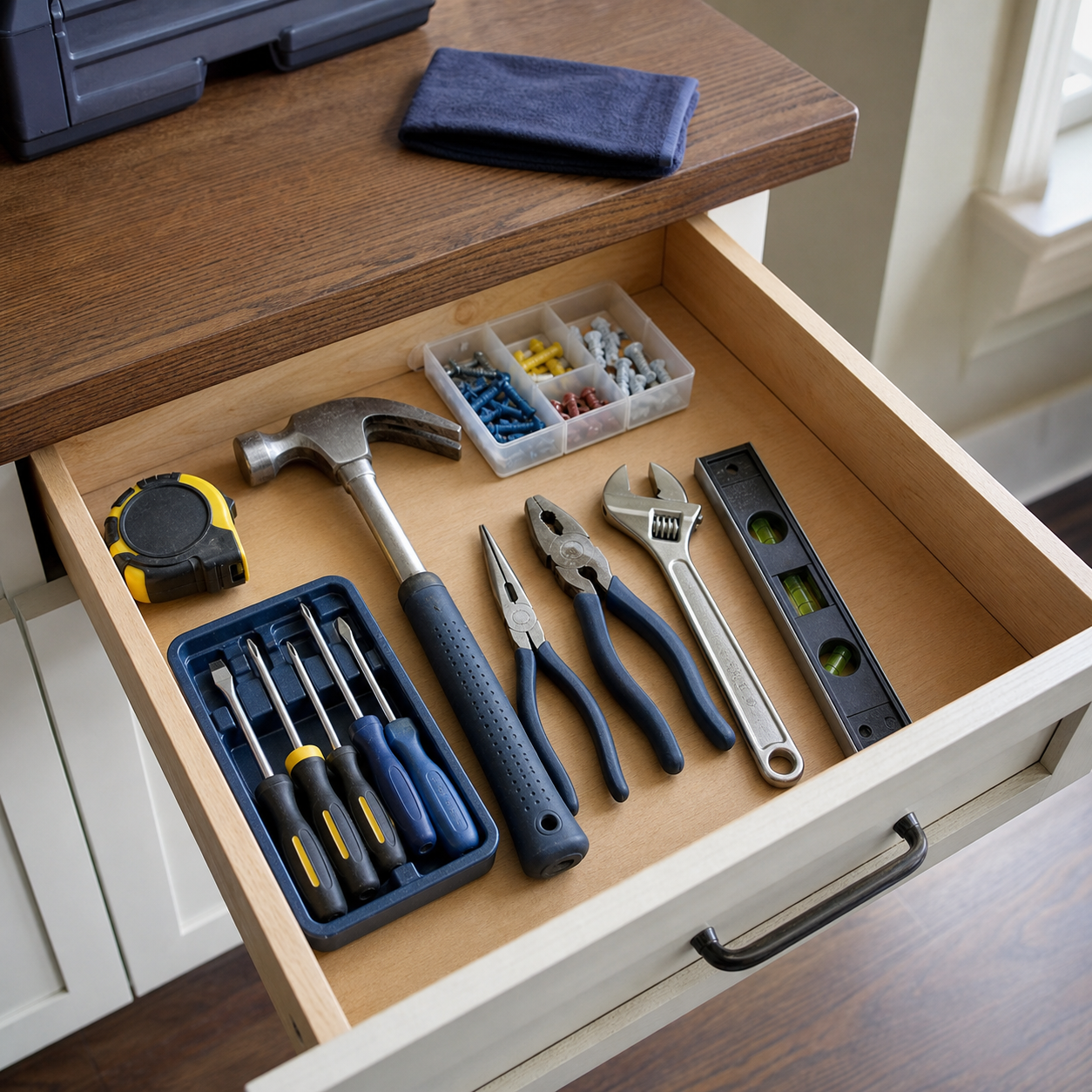
| Shallow divided drawer | Small hand tools need visible, separate places | Drawer capacity, protected edges and controlled access |
| Closed portable tote or box | Tasks happen in several rooms | Loaded weight, secure closure and parts staying contained |
| Shelf with labeled containers | Occasional tools need separate storage | Shelf capacity, retrieval height and clear access |
| Wall-mounted organizer | A suitable wall and clear layout are available | Approved fixings, load limits and safe access; resolve these before installation |
Build one everyday kit and a separate reserve
Choose the tools that match your recurring ordinary tasks: perhaps a tape measure, screwdriver system, pliers, small level and light. Give each a consistent position. Store duplicates and occasional-use items separately so the everyday kit stays understandable.
Include the accessories needed to use those tools, rather than adding unrelated pieces to increase the count. Keep cutting edges protected as their instructions require. Place emergency lighting where the household can find it without searching through sharp tools.
OSHA recommends dry storage for electric tools. Apply each item's own care instructions as well; a damp under-sink cabinet or blocked utility space should not become storage simply because it is available.
Keep consumables identifiable
Label small hardware by type and size, with a separate place for unidentified pieces. Preserve useful package information so a replacement can be matched later. A mixed pile of screws is difficult to choose from and should not become a source of guessed fixings.
Keep blades in appropriate protective storage and batteries arranged according to their exact instructions. DEWALT's battery guidance, for example, addresses compatible equipment and storage conditions for its products. That does not establish one charging or storage rule for every battery chemistry or brand. Store adhesives and cleaners by their labels, separately from ordinary hand tools where their conditions require it.
A fictional ten-minute reset
Imagine a household has finished assembling a small shelf using its familiar hand tools. The following ten-minute allocation is a fictional routine, not a measured promise; give any task more time when needed.
- Minutes 0–2: collect the tools and compare them with the inventory. Locate the missing bit before closing the case.
- Minutes 2–4: follow the tools' ordinary care instructions and check for visible changes. Set aside a screwdriver with a damaged handle and note the issue.
- Minutes 4–6: return tools to their positions, secure the cutting tool as instructed and sort leftover labeled hardware.
- Minutes 6–8: note consumables to replace and record where the shelf instructions are stored.
- Minutes 8–10: close the kit, return it to its dry location and clear the route. Leave an unresolved item labeled for follow-up rather than rushing it back into service.
Can one drawer hold everything?
Only if the items' storage needs, protective arrangements, weight and access requirements fit that drawer. Divide small parts from tools and keep hazardous items secured. Move incompatible materials to suitable storage rather than squeezing them into the remaining gap.
What should stay with a borrowed tool?
Keep its instructions, exact accessories and return information together, separately from your own small parts. Record the owner and agreed return date. Check its condition with the owner before use; borrowing does not supply training or make an unfamiliar task suitable.
When is another organizer worth buying?
Buy for a specific unresolved problem: a case that will not close, parts that escape, unsuitable retrieval or a missing protected location. First try removing duplicates and measuring the available space. Extra containers are useful only when they improve that particular arrangement.
When to call a professional
Stop and contact a qualified professional if the work involves electrical wiring, gas, structural damage, roof access, major plumbing changes, mold, lead, asbestos, or another hazardous material.
Related guides
Sources
Free next step
Download the free seasonal maintenance checklist to record observations and follow-up tasks. See the seasonal maintenance routine for more context.
Affiliate disclosure
No affiliate links appear in this guide. If a reviewed recommendation is added, the disclosure will appear beside it.