
Keep people away from water and wet electrical equipment. Stop using the water dispenser. If the refrigerator has a known, safely accessible water-supply shutoff and you are authorized and familiar with its instructions, close it; otherwise get urgent plumbing or building help for continuing water. Contact manufacturer support or a qualified appliance technician. Do not pull the refrigerator out, touch a wet plug or assume an ice-maker or cooling setting isolates the supply. Handle any loss of cooling and food safety separately.
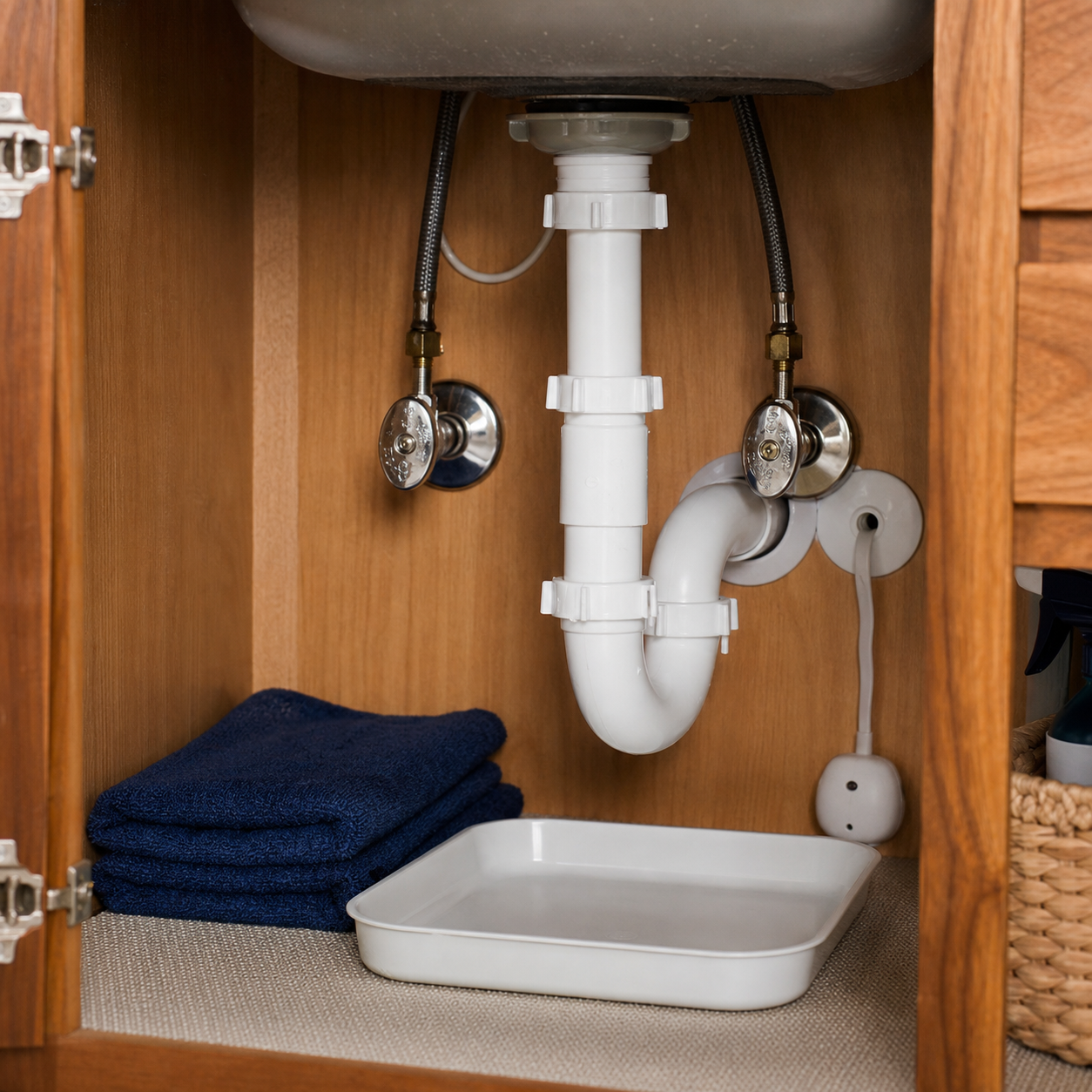

First: keep clear of water and electrical hazards
Keep children and pets out of the wet area. Do not walk through water to reach the refrigerator, a plug or a breaker. Do not touch wet controls, a cord or an outlet, or move the appliance to investigate. For immediate danger, injury, fire or suspected collapse, leave the affected area and call 911.
CDC’s flooded-home guidance warns against operating power or electrical equipment while standing in water. Keep that boundary during a kitchen leak too. If power must be made safe and access is uncertain or wet, use an electrician or appropriate emergency help. Do not reconnect equipment merely because the floor looks dry.
Separate the water supply from ice-making and cooling
Stop using the dispenser rather than filling another glass to test the leak. For a water-connected refrigerator, use only an already identified supply shutoff when it is safely accessible, you are authorized and its operation is understood. Do not force a stuck valve, disconnect tubing or operate a shared or unfamiliar control. Ask a plumber or building emergency contact if continuing water cannot be safely isolated.
Whirlpool’s current manual lookup for WRF535SWHZ lists owner instructions W11304737B. Its planned-absence section treats shutting off the household water supply and turning off the ice maker as separate actions. Its control section separately describes stopping cooling. This illustrates distinct functions; it is not an emergency shutoff sequence for every refrigerator.
Do not assume that an ice-maker setting, cooling display, vacation setting or app message closes the household water supply or disconnects electrical power. Use the actual installed model’s instructions and qualified help. A closed supply also does not remove water already in the appliance, and it will not resolve every possible drainage or moisture problem.
A puddle location is useful evidence, not a diagnosis
Whirlpool’s floor-water support lists drainage, door sealing and supply components among possible areas. It also discusses filter compatibility and water connections. That does not make every puddle a failed filter, a loose hose or a blocked drain. Some refrigerators have no household water connection.
Report where water was first seen and what was already happening: dispensing, a recent filter change, cleaning or no known activity. Do not dispense again, open a drain, pour hot water into an opening or dismantle a filter housing to prove a theory. Keep refrigeration-system and internal repairs for qualified service.
| Situation | Next useful contact or action |
|---|---|
| Wet electrical equipment or unsafe access | Keep clear; arrange urgent electrician or emergency help. |
| Continuing supply water or a leaking house valve | Urgent plumber or building emergency contact for safe isolation and house plumbing. |
| Leak seems associated with the appliance or filter area | Manufacturer support or qualified appliance technician; report the full model and recent work. |
| A wet ceiling or electrical fitting below the kitchen | Keep people away; follow the ceiling-leak response and notify the building contact. |
| Cooling interrupted or food history uncertain | Use FDA food-safety guidance promptly alongside appliance repair; a cold reading later cannot clear earlier exposure. |
If it began after a filter change, keep the exact details
Keep the filter packaging or its exact identifier and note when it was installed. Give support the refrigerator’s full model and suffix from existing records. Whirlpool’s general support directs owners to the actual Use & Care Guide for compatibility, installation and locking; a similar-looking cartridge is not enough.
Do not remove and reseat a filter during an active leak on the assumption that every model depressurizes or isolates water the same way. Ask for the applicable safe procedure first. Do not install a bypass or turn the supply back on as a test unless the actual instructions and safe conditions have been established.
Protect food without delaying electrical safety
If cooling was interrupted or the refrigerator is warm, handle the food question promptly as a separate job. FDA advises keeping the refrigerator at 40°F or below and the freezer at 0°F. Use its current food-storage and outage guidance for the actual temperature history; do not taste food to decide whether it is safe.
Keep doors closed as much as possible during a power interruption, provided doing so does not require approaching unsafe equipment. If the exposure history cannot be resolved, follow FDA’s advice rather than waiting for the appliance to cool again. A new cold reading does not reconstruct earlier conditions.
The refrigerator-setting-versus-temperature guide explains control settings, suitable thermometers and comparable routine checks. Do not wait through a routine measurement or adjustment interval while an urgent food-safety decision remains open. Keep repair, electrical clearance and food decisions distinct.
Copy this short repair-call note
Call first for continuing water or unsafe conditions. Complete this private record only from safe observations and existing appliance information. Photos are optional; do not move the refrigerator or reach behind it to obtain one.
- Affected area, immediate hazard and whether water continues: ___.
- Time first noticed and first visible location: ___.
- Full model/suffix; household water connection known, absent or uncertain: ___.
- Dispenser use, filter replacement or service already performed before the leak: ___.
- Exact filter identifier or displayed message, if already available: ___.
- Known valve or controls used, by whom and when: ___.
- Cooling interruption, temperature observations and food follow-up needed: ___.
- Appliance, plumber or building case number; source-repair and drying responsibilities: ___.
Example: water appears after a filter replacement
Fictional example: a household notices water near the refrigerator after replacing a filter. They stop using the dispenser, keep clear of the wet area and use the known accessible supply shutoff only under its established safe instructions. They contact support with the full refrigerator model, filter identifier and timing.
Their report is “water appeared after replacement; source unconfirmed.” They do not pull the refrigerator forward, keep dispensing or conclude that the new cartridge caused the leak. If safe access is unavailable, qualified help takes over. Any cooling interruption gets a separate food-safety follow-up. This is a response example, not a diagnosis or promised repair.
Close the source-repair and wet-material jobs separately
A towel or shallow container can limit a small safely reachable drip after hazards are controlled. It does not establish that the appliance or concealed floor is safe. Do not plug in a wet vacuum, fan or dehumidifier before electrical safety and the water’s condition are established.
EPA advises promptly fixing water problems and drying water-damaged materials within 24–48 hours to help prevent mold. Arrange timely assessment; that is not a safe waiting period or proof that hidden flooring or cabinetry is dry. Use qualified help for significant damage, suspected contamination or uncertain concealed wet areas.
Ask who will repair the source, assess affected materials and supply the instructions for restoring normal use. Record unresolved tasks on the free homeowner checklist. An emptied tray, stopped drip, silent alarm or dry-looking floor does not complete all those jobs.
Tell service if the refrigerator uses an RO supply
If existing records show that the refrigerator is supplied through a reverse-osmosis system, include the treatment-system model and branch arrangement in the repair call. Do not assume a refrigerator setting stops the RO feed or isolates stored water. Do not move either appliance, disconnect tubing or dispense again to find the source.
The RO-leak guide adds feed/tank/drain and qualified isolation questions. Ask the appliance provider and water-treatment installer or plumber who handles the actual branch and supplies return-to-use instructions. Keep refrigerator cooling and food-safety decisions alongside the source repair, without treating them as proof of water-treatment performance.
Food touched by water has a different question from lost cooling
If escaped water may have contacted food or its package, record that separately from the refrigerator’s temperature history. Keep the item unused while applying official food advice; do not taste it, assume a closed jar is floodproof or treat a later cold reading as proof about contamination. Do not approach wet equipment or move the refrigerator to complete an inventory.
The food-exposure guide adds a package/contact decision table and a fictional repaired-line example. It keeps flood/sewer rules distinct from an ordinary household leak and separates completed food decisions from source repair, safe water use and kitchen recovery. A repaired feed line does not itself clear affected food.
A separate countertop ice maker needs its own water-path report
For a separate reservoir-fed countertop ice maker, use its own safe stopping and service instructions. A refillable reservoir or optional side tank is a different arrangement from a refrigerator’s built-in ice-maker feed; do not assume an ice-making control closes a supply or that every countertop unit has a household water connection. Keep wet power and unsafe access on the urgent qualified-help path.
The countertop-ice-maker leak guide adds a contact table, a fictional raised-side-tank example and private repair prompts. It distinguishes intended internal meltwater from escaped counter water and keeps appliance repair, actual plumbing connections, electrical assessment and any ice/water-use question separate. Do not refill, reposition a tank or remove tubing to test a suspected cause.
When to call a professional
Stop and contact a qualified plumber or other appropriate professional if water is actively spreading, you cannot safely find the shutoff, the leak involves a wall or ceiling, or a repair would require changing plumbing.
Related guides
Sources
- Whirlpool: Water on the Floor — possible refrigerator leak areas and model-specific care
- Whirlpool: Owner instructions W11304737B — separate water supply, ice-maker and cooling actions (PDF, pages 13–16)
- Whirlpool: Official manual finder — match the full installed model
- FDA: Refrigerator Thermometers — Cold Facts about Food Safety
- CDC: Reentering Your Flooded Home — electrical safety boundaries
- EPA: A Brief Guide to Mold, Moisture and Your Home — source repair and prompt drying
- Watts H2O-DWRO300: IOM-WQ-H2O-DWRO300 2422, 2024 — system paths, water-quality limitation and troubleshooting; exact-model scope
- Watts Designer703 air-gap faucet: IS-WQ-FCT703AG REV1646 — drain-path example, not universal tubing instructions
- APEC: RO Pump Leaks — possible locations and manufacturer support
- CDC: Keep Food Safe After a Disaster or Emergency — water contact, packaging and separate cooling history
- FDA: Food and Water Safety During Power Outages and Floods — flood packaging limits and full official container procedure
- CDC: Keeping or Discarding Packaged Food — floodwater contact and closure types
- Illinois DPH: Cleaning Up After Flood and Sewer Overflows — contaminated-food and sewer-water precautions only
- CDC: Drinking Water Advisories — actual restrictions and connected appliances
- ESFI: Water-Damaged Electrical Equipment — qualified evaluation before return to power
- EPA: Mold Cleanup in Your Home — source correction and contaminated-water professional help
- GE Appliances: XPIO13BCBT support gateway — match the model and currently linked owner manual
- GE Opal: Owner manual 49-9000075 Rev. 2, 12-25 — safety, display, internal water and side-tank scope (pages 3, 5–7, 10–14, 20)
Free next step
Download the free seasonal maintenance checklist to record observations and follow-up tasks. See the seasonal maintenance routine for more context.
Affiliate disclosure
No affiliate links appear in this guide. If a reviewed recommendation is added, the disclosure will appear beside it.